
Stretch film is an elastic, self-clinging PE film that wraps a load tight for transport, and choosing it comes down to three numbers — thickness in microns, roll width, and hand or machine application — plus the weight of your load.
What is stretch film, and why the name?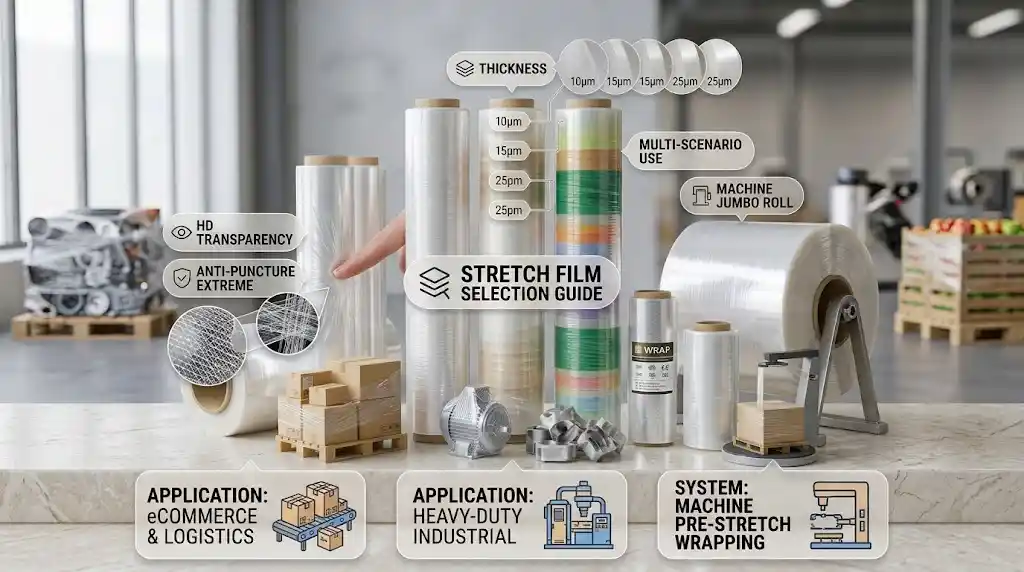
Stretch film, also called stretch wrap or pallet wrap, starts from linear low-density polyethylene (LLDPE), often with a little LDPE blended in. You wrap it around a pallet or a bundle, pulling it tight as you go. The film’s elastic memory then snaps it back and holds the load in place. Two details make it different from other packaging films:
- It clings to itself — layers stick together without glue or heat.
- It needs no heat — tension alone does the holding.
So that is also why it carries the name: the user stretches it while applying it.
How to read stretch film specs
Suppliers quote three main numbers, and mixing them up causes most ordering mistakes.
Thickness. The world mostly quotes microns (μm); North America still uses gauge. The conversion is simple: 1 gauge = 0.254 micron, so 80 gauge is about 20 microns and 100 gauge about 25 microns. Hand-wrap film commonly runs 17–23 microns, machine film 20–30 microns.
Width. In general, hand rolls usually come in 450 mm or 500 mm, while machine rolls are typically 500 mm. Width should cover the load face with a little overhang for a secure hold.
Roll length and net weight. Meanwhile, a standard hand roll often weighs 2–3 kg net; machine rolls run longer. Length matters because a lighter roll means more roll changes per day.
Hand wrap vs machine wrap
The two applications use different films, and you cannot simply swap them.
- Hand wrap film (about 17–23 microns) gives you more control. It suits small batches, irregular loads, and packing areas without a wrapper. You apply it by hand, so stretch rates are lower and more variable.
- Machine wrap film (about 20–30 microns) runs on semi-automatic or automatic turntable wrappers. The machine pre-stretches the film 200–300% before it reaches the load, so you use fewer grams of film per pallet. It suits high-volume, uniform loads.
For example, a warehouse wrapping dozens of pallets a day usually moves to machine film; a workshop wrapping a few bundles now and then stays with hand film.
Which thickness fits your load?
As a rough guide, match thickness to what you ship:
- 12–15 microns — light cartons, clean warehouse use, retail bundling.
- 17–20 microns — regular hand wrapping of medium loads.
- 20–23 microns — standard pallet loads, hand or light machine use.
- 23–28 microns — heavier pallets and machine wrapping.
- 28–35 microns — heavy, sharp or unstable loads that need puncture resistance.
These are starting points, not fixed rules. In short, heavier and sharper loads need more microns; lighter and smoother loads can use less.
How to choose in four steps
- Check your load weight and shape. Heavy or sharp items push you toward the higher microns.
- Pick hand or machine film. Decide how often you wrap and whether you have a wrapper.
- Choose a thickness range. Start from the guide above, then adjust for your specific product.
- Confirm width and net weight. Match the width to your load face, and pick a roll weight that matches your wrapping frequency.
If you are still not sure, send us your product, pallet size and wrapping method (manual or machine). We will confirm the right stretch film size and thickness for you.
Note: film choice also depends on the wrapping equipment, pre-stretch setting, and how sharp the load edges are. So confirm the final spec with us before ordering.
Looking for more? See how shrink film vs stretch film — which one you need and our guide on choosing the right film thickness.
Source notes
- Lintyco, The Complete Guide to Packaging Film in 2026 (2026-07): stretch film typical specs 17–30 microns LLDPE, hand or machine applied, elastic recovery, no heat, pallet stabilization.
- Stavian Packaging, PE Stretch Film vs BOPP Film (2026-05): stretchability 200–300% with elastic recovery.
- Packrift, Stretch Film Gauge Chart (2026-08): gauge-to-micron conversion (1 gauge = 0.254 micron; 80 gauge ≈ 20 microns).
- JYE Stretch Wrap, How to Choose Stretch Film Thickness (2026-06): 12 μm light cartons, 15 μm regular hand wrapping, 17 μm general pallet packaging.
- QIS Packaging, Stretch Wrap Gauge & Micron Guide (2026-09): 20 μm uniform carton loads; 80 gauge ≈ 20 μm, 100 gauge ≈ 25 μm.