
A pre-coated film is a BOPP roll coated in the factory with an EVA hot-melt adhesive, so it bonds under heat and pressure without on-machine glue mixing. It comes in gloss and matte surfaces: gloss for a bright reflective finish, matte for a low-sheen velvety touch, and both serve book, box, gift and label packaging.
What a pre-coated film actually is
A pre-coated film has two layers. The BOPP top film supplies sheen, abrasion resistance and moisture protection; the EVA hot-melt layer is coated under controlled conditions at the plant. On the laminator, the printed sheet and film pass through heated rollers, where the adhesive activates at 85–110°C and bonds on contact. No glue is mixed, coated or dried on site.
Compared with water-based or solvent lamination, pre-coating shortens the line, removes solvent fumes and avoids glue-tank cleaning. It runs on manual small-batch feeds as well as high-speed roll-to-roll lines. Common thickness is 18–27 μm (BOPP base 12–18 μm, adhesive layer 6–12 μm), the EVA coating sits around 3–6 g/m², peel strength targets ≥1.5 N/mm, and thickness tolerance follows QB/T 2889-2007.
Pre-coated gloss film vs pre-coated matte film
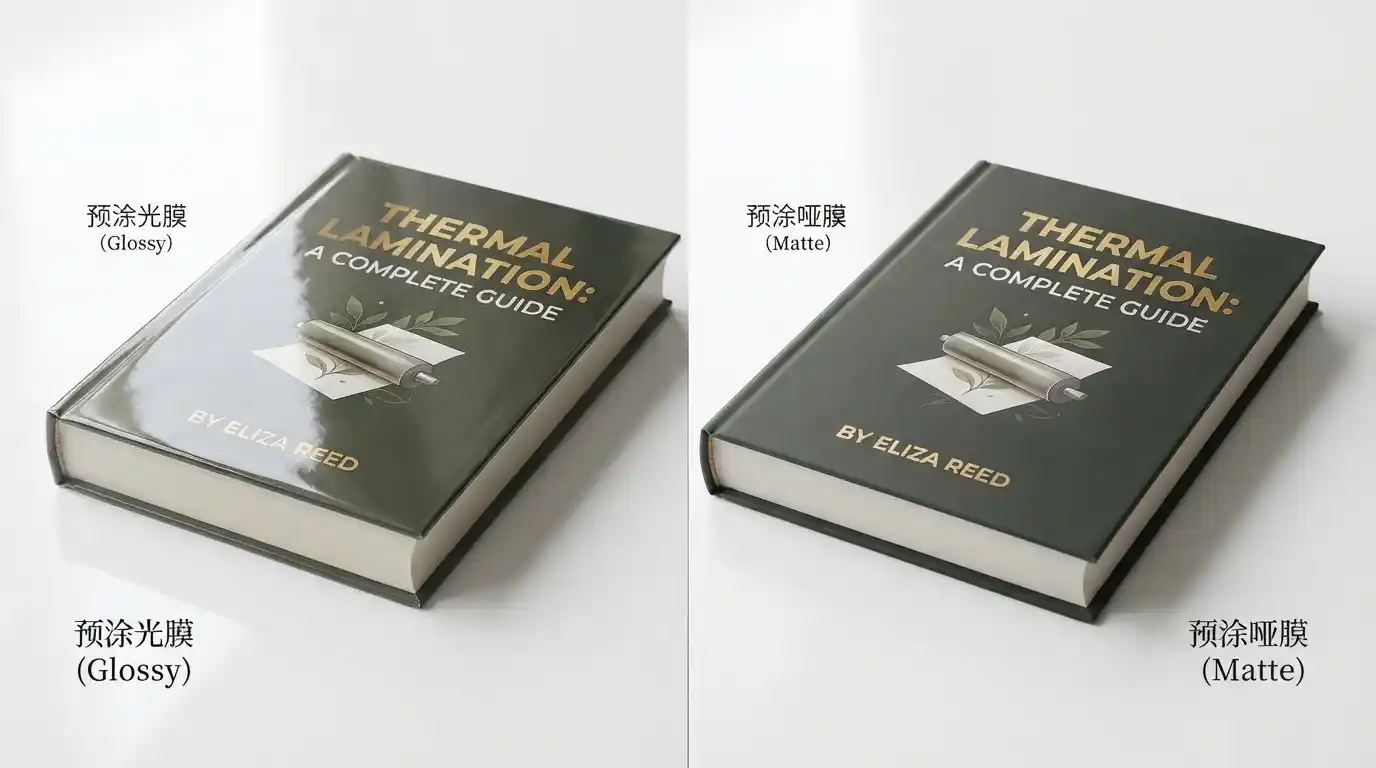
The base film and adhesive are the same; the difference sits in the top surface:
|
Point
|
Pre-coated gloss film
|
Pre-coated matte film
|
|
Sheen
|
high gloss, high clarity
|
low sheen, frosted touch
|
|
Reflection
|
reflective, vivid color
|
glare-free, calm tone
|
|
Feel
|
smooth and flat
|
soft and fine
|
|
Style
|
bright and eye-catching
|
understated, premium
|
|
Typical use
|
covers, gift boxes, labels, flyers
|
hardcovers, art books, tobacco and liquor boxes
|
Gloss deepens and brightens printed color, so it suits covers and packaging that need impact. Matte cuts glare and gives a fine touch, so it fits art books, hardcovers and gift boxes where light spots must not show. Matte often costs slightly more per roll at comparable specs; confirm against the actual quote.
Which industries use pre-coated film
- Book publishing: covers, softback textbooks, art books, calendars, greeting cards, certificate covers.
- Package printing: folding cartons, gift boxes, hang tags, labels, paper bags.
- Graphic and print shops: flyers, posters, menus, display boards, brochures.
- Stationery and paper goods: notebook covers, photo albums, folder covers.
Pre-coated film adds a protective layer to printed matter; it is not a direct food-contact film. For direct food packaging, choose a food-grade packaging film instead.
How to choose gloss or matte
Work backwards from the finished piece: hardcovers and rigid boxes take the heavier 24–27 μm, foldable art books and flyers use the lighter 18–22 μm. Add 5–10°C for coated or heavy paper; roller pressure runs 8–15 MPa normally, 16–25 MPa for thick or rough stock; manual and semi-auto lines run 5–30 m/min, high-speed laminators up to 70 m/min.
Trial a small roll before a bulk order: check peel strength, cracking after folding, and bubbles on the surface. Send your machine width, paper weight and application to set the spec and roll length.
Common questions
Is a pre-coated film the same as a gloss film? Gloss or matte describes the top surface; pre-coated describes how the adhesive is applied. A gloss film can be pre-coated, and a matte film can be pre-coated; the two labels describe different properties.
Can pre-coated film replace heat-seal film? No. Pre-coated film bonds to a printed sheet through heat and pressure on a laminator; heat-seal film forms a package seal on a bag or wrapping line. They serve different jobs, even when the base material is BOPP.
Why test a small roll first? Peel strength depends on temperature, pressure, dwell time and the paper coating. A trial roll shows whether the surface bubbles, the fold cracks, and the bond holds on your actual stock.
Browse our BOPP glossy film for book lamination and BOPP matte film, paired with our thin-film laminator. For the base material, see biaxially oriented polypropylene.