
Choosing BOPP tape base film is not about chasing the highest values on datasheets. So the core rule is to align thickness grade, corona value and MD tensile strength with your coating line and end carton sealing application.
Tape-grade BOPP film is a simplified formulation branch of plain BOPP film. Its target corona level is a modest 36–38 dyne/cm, much lower than printing BOPP film above 42 dyne/cm. Meanwhile, it requires MD tensile strength ≥150 MPa to keep film running stably during coating and sealing. However, paying extra for printing-grade features you do not need will not cut real cost. If you use printing film or plain BOPP film for adhesive coating, high scrap rates will eat up all material savings quickly.
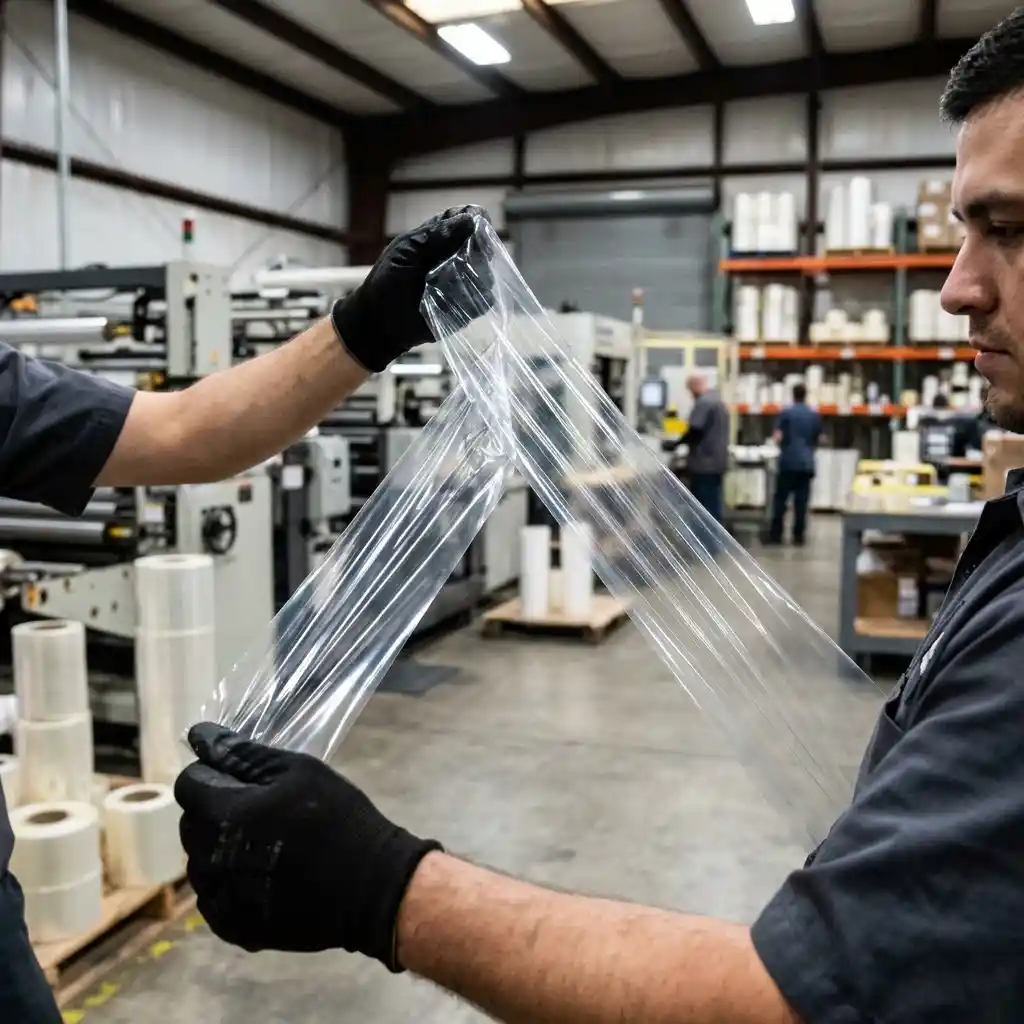
Thickness: set micron size by carton application
Tape-grade BOPP base film covers 20–58 μm, while most practical selections fall in 25–50 μm. Thickness does not equal adhesive force directly — it defines the load limit of tape during unwinding, sealing and tension.
- 25–28 μm: thin general sealing tape, a balanced mix of cost and strength, highest sales volume
- 28–32 μm: standard carton sealing, benchmark thickness for most coating lines
- 35–50 μm: heavy-duty packing, export cartons and rough recycled board, extra puncture resistance
For example, watch out for the total-thickness pitfall: finished tape marked 45 μm or 50 μm means base film plus dry adhesive together. The real BOPP base film usually sits around 28–30 μm. Two rolls with the same total 52 μm thickness can perform differently: one is 28 μm base film + 24 μm dry adhesive, the other 30 μm base film + 22 μm dry adhesive. Their tensile force and initial tack are not the same. So confirm base film thickness and dry coating thickness separately during inquiry, instead of checking total thickness alone.
In short, thickness tolerance is non-negotiable. Premium tape-grade BOPP base film controls tolerance within ±2.5% or less. Larger tolerance causes uneven glue spread along the roll length, leading to inconsistent tape tack.
Corona value: factory value ≠ value when you receive goods
PP is non-polar. As a result, untreated BOPP has surface tension around 29–31 mN/m, too low for adhesive wetting. Reliable coating needs proper corona treatment. Below 38 dyne/cm, adhesive anchoring becomes weak and delamination risk rises sharply.
However, the biggest hidden trouble is corona decay. Meanwhile, surface tension drops over storage time, affected by temperature, humidity and migration of slip agents or antistatic additives inside film. Even in good warehouse conditions, corona may lose 2–3 dyne/cm after 6 months storage. The 38–42 dyne/cm marked on TDS is the factory output value, not incoming value at your workshop.
In addition, width uniformity is another easy-miss point. If the film center reads 40 dyne/cm but edges drop to 34 dyne/cm, finished tape will lift at edges after coating. So your QC team must test left, middle and right points with dyne pens for every incoming roll. Follow FIFO stock control to keep film within valid processing window.
Actually, for tape production, 36–38 dyne/cm is enough. You do not need printing grade 42 dyne/cm or lamination grade 44 dyne/cm. Uniform corona across full width brings more practical value than a high nominal number.
Tensile & elongation: MD for break resistance, TD for running stability
After biaxial stretching, BOPP film has separated molecular orientation in MD and TD direction. Tape base film requires MD tensile strength ≥150 MPa, and MD elongation at break ≤180%. In practice, MD tensile strength decides whether the tape breaks during unwinding, laminating and tension. Film barely meeting the lower limit will cause frequent machine stop on high-speed carton sealers.
Also, elongation must be reviewed together with tensile strength. Film near the upper elongation limit will stretch under coating tension, resulting in wrong slit width and uneven winding tightness. Good tape base film is strong with limited extra stretch.
Price gap & unsuitable cross-grade use
Tape-grade BOPP is cheaper than printing grade and lamination grade, because it removes strict requirements on high corona, surface flatness and crystal points which printing actually needs. For producers of clear sealing tape, tape-grade BOPP is the right choice. Similarly, extra cost for printing grade brings zero improvement on peel strength or unwinding feel.
So do not trust “one film for both tape and printing”. The formulations conflict. However, more slip agent reduces delamination risk for tape but causes bad printing. Less slip agent helps printing but creates sticky running issues on coating lines. You can check our BOPP film applications guide here: BOPP film applications guide.
3 practical incoming inspection steps better than reading TDS
- Test incoming dyne value at left, middle and right of film width, do not trust printed labels alone.
- Separate base film thickness and dry glue thickness to avoid thin base film hidden by total thickness.
- Finally, run a trial coating before long-term order. Verify peel strength, unwinding noise and slit break frequency on your own line. Nice datasheets mean nothing if the film cannot run smoothly on your coating machine.
To wrap up: set the thickness grade by carton application, then make sure incoming corona stays ≥38 dyne/cm with uniform width performance, and match MD tensile strength to your coating machine tension. When these three factors all match, you get suitable BOPP tape base film instead of overpriced over-spec material.
Read more about the hidden costs of cheap BOPP film and this OPP/BOPP buyer guide.
Source notes
- Technical values (corona 36–38 dyne/cm for tape grade, MD tensile strength ≥150 MPa, MD elongation ≤180%, corona decay 2–3 dyne/cm per 6 months) follow common tape-grade BOPP industry specifications provided by the customer.