
Inner or outer heat seal describes which side of the BOPP film carries the CPP seal layer. Getting this side wrong means the wrapping machine cannot form a proper seal — even when the thickness and grade are correct.
The core idea: a film has two sides
A heat-sealable BOPP film is a multilayer structure. One side is the BOPP base layer — matte, glossy or corona treated, used for the outside appearance and printing. The other side is the CPP seal layer, a low-melting skin that bonds to itself under heat and pressure.
The question is simple: which side of the roll should the CPP layer face when it runs through your machine? That choice gives you two standard grades — inner seal and outer seal.
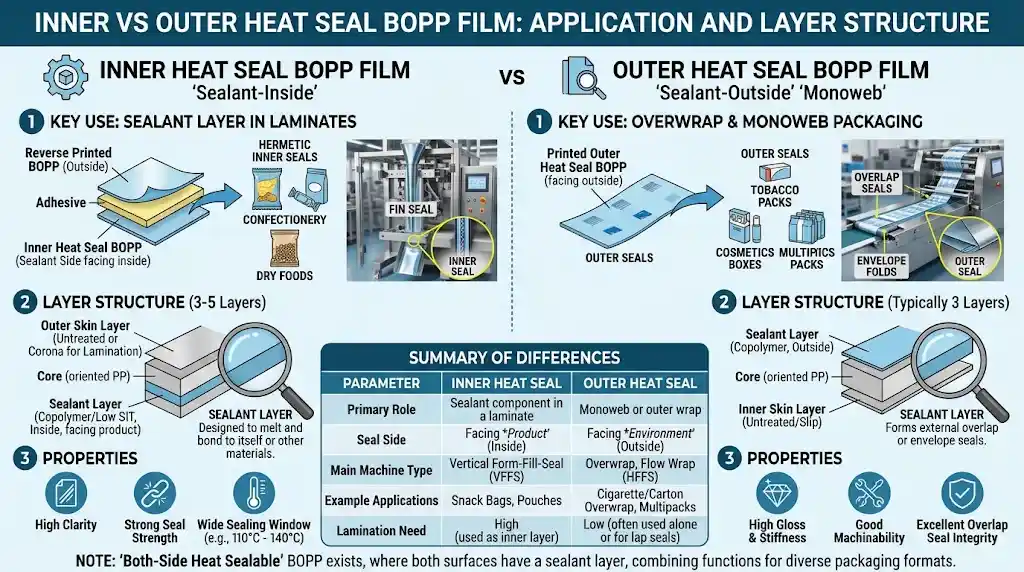
Inner heat seal: CPP layer faces the product
With inner heat seal film, in practice, the CPP seal layer sits on the inside of the roll. After the film is pulled through the forming shoulder, the CPP layer ends up on the inside of the finished bag, touching the product. The matte or printed BOPP face stays on the outside.
In this setup, the longitudinal seal and the end seals both bond CPP-to-CPP on the inner side of the package. This is the most common configuration.
Typical uses:
- Pillow packs and flow-wrap bags for snacks, candy and bread
- Three-side seal bags and stand-up pouches
- Hotel amenity and tableware overwrap
- Products where the outside needs a clean matte or printed finish
Outer heat seal: CPP layer faces outward
Outer heat seal film has the CPP layer on the outside of the roll. When the film path runs through the machine, the CPP layer ends up on the outside of the bag edges, while the matte face faces inward.
In contrast, this grade is chosen when the machine’s film path, folding style or package design requires the seal layer to land on the outside. In practice, it is used for specific wrapping formats where the film is folded or reversed.
Typical uses:
- Folded or envelope-style wraps where the seal lands on the outer edge
- Certain horizontal flow-wrap lines with a reversed film path
- Special packaging where the inside surface must be matte or printed
What happens if you order the wrong side
In practice, the most common production problem is not the film itself — it is ordering the wrong side.
For example, if your machine expects inner-seal film but you load outer-seal film, the seal bars will press the BOPP base layer against another BOPP base layer. BOPP does not heat-seal to itself at normal jaw temperatures, so the seal will be weak or open. You will see leaking edges, burst bags on the line, and frequent machine stops.
Similarly, running inner-seal film on a line built for outer-seal film gives the same weak seal. Nevertheless, thickness, width and grade may all be correct, but the seal still fails.
How to choose: ask three questions
- Which way does your machine thread the film? Check the film path drawing from your equipment supplier. The seal layer must land on the side that actually touches the seal jaws.
- Which face should be visible outside? If you want matte or printed graphics on the outside, you usually need inner seal — the BOPP face stays out.
- Does the package design fold or reverse the film? If yes, outer seal may be the correct grade.
When in doubt, send us your machine model, film path sketch and package type. We will confirm whether your roll should be inner-seal or outer-seal before you order.
A third option: two-side heat seal
Alternatively, some converters choose two-side heat sealable BOPP, where both surfaces can seal. This removes the risk of loading the wrong side on lines with variable film paths. However, it usually costs more and the matte or print finish is slightly affected. In short, for a fixed production line, one-side seal film is more economical and gives a cleaner outer finish.
Note: final seal strength also depends on jaw temperature, dwell time and pressure. Confirm the full sealing window with your machine and our technical team.
Browse our matte BOPP film product range and read more about OPP transparent packaging film applications.
Source notes
- CloudFilm, Heat Sealable BOPP Film Buyer’s Guide: one-side vs two-side sealable grades; confirm web orientation and sealant side.
- Saillage, Heat-sealable BOPP film applications: one-side sealable outer side stays printable; two-side needed for fin and overlap seals.
- Kingchuan Packaging, Heat Sealable BOPP Film: multilayer structure with inner heat-sensitive layer.
- Protos Packaging, BOPP Packaging Film: heat seal temperature 105–140°C by grade.