PE stretch film is an elastic, self-clinging wrap that holds loads together for transport, while BOPP film is a stiff, glossy, heat-sealable film that overwraps product packs for display and protection — two different packaging jobs that get mixed up because both names contain “film” and “stretch.”
Why these two get confused
Ask for “stretch film” and one supplier sends you a roll of PE wrap; another sends you BOPP. The confusion is real, and it has a simple cause.
In daily packaging talk, “stretch film” usually means PE stretch wrap — the elastic film you pull tight around a pallet or a bundle. BOPP film, however, goes through its own “stretching” during manufacturing: the machine draws the polypropylene sheet in both directions to make it strong and clear. As a result, the word “stretch” describes what the user does with PE, and what the machine does to BOPP. In short, the two films are not the same thing.
What is PE stretch film?
PE stretch film starts from linear low-density polyethylene (LLDPE), and suppliers usually blend in a little LDPE to fine-tune the feel. You buy it in rolls and wrap it by hand or by machine around a load. As you apply it, you pull the film tight; its elastic memory then snaps it back and holds the load in place.
Key traits:
- Around 200–300% stretchability with good snap-back — the film gives and returns.
- Self-clinging surface, so the layers stick to each other without glue or heat.
- No heat needed — tension alone does the holding.
- For instance, typical hand-wrap gauges run around 17–30 microns.
Main jobs: pallet wrapping in logistics and warehousing, bundling cartons, pipes and industrial goods, and export protection against dust and moisture.
What is BOPP film?
BOPP stands for biaxially oriented polypropylene. To make it, manufacturers melt the polypropylene base, cast it into a sheet, draw it in both the machine and transverse directions, and heat-set it. That orientation gives the film its stiffness, clarity and dimensional stability.
Key traits:
- High transparency and gloss, so the product shows through clearly.
- Stiff and dimensionally stable — the film holds its shape instead of stretching.
- Excellent printability — brands, logos and instructions print crisp.
- Heat-sealable (with a sealing coating); the heat seals the pack closed, typically at around 100–140°C.
- Good moisture barrier, which helps protect dry goods.
- Similarly, typical gauges run around 15–40 microns, depending on the job.
Main jobs: overwrapping cigarette packs, food (snacks, confectionery, dried goods), cosmetics and daily products; printed labels and lamination; and a large share of BOPP demand goes to food packaging.
PE stretch film vs BOPP film: side-by-side
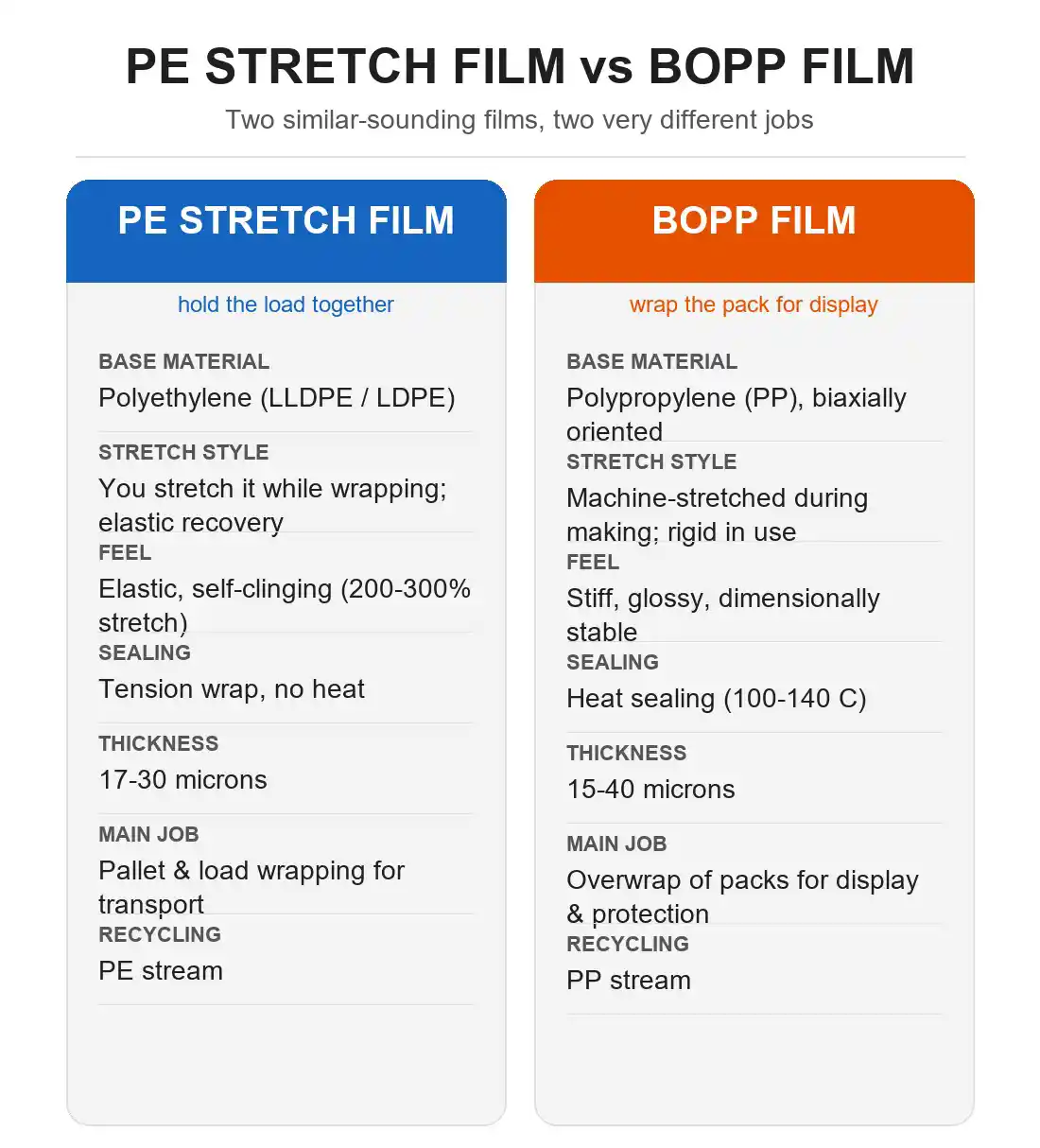
The chart above compares the two films across material, stretch style, feel, sealing, thickness, main job and recycling stream. In short, PE stretch film wraps a whole load with tension, while BOPP film wraps a single pack with heat.
Which one does your order need?
So, ask what the film should do:
- Holding a stack together for shipping or storage? Use PE stretch film. It wraps the load, clings to itself, and absorbs the knocks of transport.
- Wrapping a single pack so it looks clean on the shelf and seals tight? Use BOPP film. It overwraps with heat sealing, prints your branding, and stays clear.
- Both? The two films serve different stations — many packers run PE in the warehouse and BOPP at the packing line, and order them separately.
If you are not sure, send us your product, the box or pack size, and how you plan to wrap (manual or machine). We will confirm which film fits — and the correct film size for your pack.
Note: film choice also depends on the wrapping equipment, sealing overlap and the product’s sensitivity to heat. So confirm the film type and size with us before ordering.
Looking for more? Read our guide on why BOPP film is used so widely in packaging and compare shrink film vs stretch film — which one you need.
Source notes
- Stavian Packaging, What are the differences between PE Stretch Film and BOPP Film? (2026-05): base polymer PE vs PP; stretchability 200–300% with elastic recovery vs low/rigid dimensionally stable.
- Alliance Packaging Group, Comprehensive Guide to Polymer Films in Packaging (2026-03): BOPP high tensile strength, dimensional stability, moisture barrier, optical clarity, printability; large share of BOPP demand in food packaging.
- Lintyco, The Complete Guide to Packaging Film in 2026 (2026-07): stretch film typical specs 17–30 microns LLDPE, hand or machine applied, elastic recovery, no heat, pallet stabilization.
- Sealing temperature range 100–140°C for BOPP per product data listed on Alibaba BOPP film introduction (2026-10).