
One of the most common questions buyers ask is how to choose shrink film thickness. Pick a film that is too thin and it tears during sealing, punctures on corners, or splits in the heat tunnel. Pick one that is too thick and you overpay on material, slow your tunnel, and struggle to get a neat shrink. This shrink film micron guide walks you through the load factors and gives you a simple shrink wrap thickness chart to work from. For sealing trials, a reliable handheld heat sealer can also make sample testing easier.
Why Thickness Matters
Shrink film thickness is measured in microns, or in mils in some markets (one mil equals roughly 25.4 microns). Thicker film gives more puncture resistance and a tougher bundle, but it also uses more resin, needs more heat to shrink, and costs more per package. Thinner film is cheaper and runs faster, but it is less forgiving on sharp edges, heavy bottles, or rough handling. The goal is the lightest film that still survives your sealing, shrinking, and shipping process. On fast retail lines, a POF cross-linked film is often chosen for its thin-gauge clarity and reliable shrink.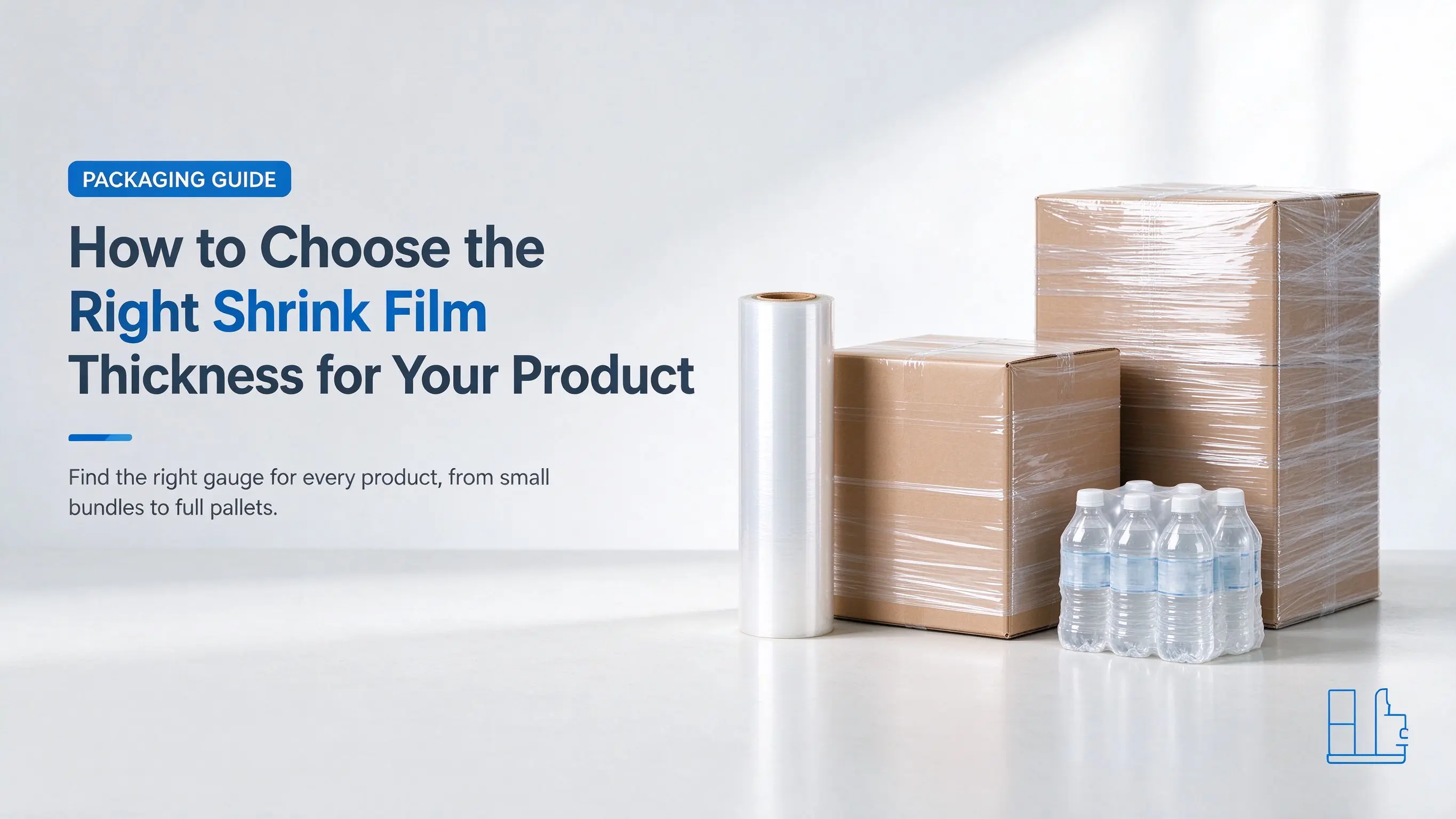
Factors That Drive Your Thickness Choice
Product Weight and Shape
Heavy or rigid products need tougher film. A full bottle or a glass jar presses on the film during shrink, and sharp corners puncture thin gauge. Lighter, smooth goods such as folded paper goods can run on thinner film. For heavier or more rigid loads, step up to a tougher grade such as BOPP heat-sealable film or BOPP heat seal film for hardware parts.
Sharp Edges and Corners
Cartons with exposed corners, plastic housings, and multi-bottle packs create stress points. If your product has hard edges, move up one gauge rather than trying to stretch a thin film over them. Protective formats such as trapezoidal bags can also reduce corner stress in some pack designs.
Tunnel Temperature and Speed
Thicker PE film needs a hotter or slower tunnel to fully shrink. If your line runs fast, a thinner gauge will complete the shrink cycle reliably. Always test at your actual tunnel settings, not in isolation, and follow recognized methods such as ASTM D2732 for unrestrained linear thermal shrinkage of plastic film.
Retail vs. Industrial Use
Retail-facing packs benefit from a thinner, glossier film that looks crisp on the shelf. Industrial multipacks prioritize durability and may accept a thicker, more robust film. Retail options include BOPP glossy film, BOPP matte film, and BOPP pearl film. For industrial durability, BOPP heat seal film for hardware parts is a practical reference. Specialty packs may also need dedicated films, such as anti-fog flower wrapping film, BOPP anti-fog film, BOPP seaweed packing film, BOPP heat sealable film for disposable cutlery, BOPP tear tape cigarette film, and BOPP mask heat sealing film.
A Simple Shrink Wrap Thickness Chart
Use this as a starting point, then validate with a trial run on your line:
| Product type | Typical film gauge |
|---|---|
| Light paper goods, small boxes, labels | 12–15 microns |
| Retail boxes, books, cosmetics | 15–20 microns |
| Beverage multipacks, bottles, cans | 40–70 microns (PE) |
| Heavy drums, irregular rigid loads | 70–100+ microns (PE) |
This table is a rough PE film thickness for packaging reference. POF retail films commonly run 12 to 25 microns, while PVC and BOPP grades sit in a similar thinner range. Always confirm the recommended gauge with your film supplier for your specific product. For pre-cut retail wrapping, BOPP cellophane overwrap film / pre-cut wrap sheets can also be part of the thickness decision.
Packaging Format Matters
The way you build the pack also affects gauge. A centerfold overwrap around a rigid box needs less film than a sleeve around a loose multi-bottle array, because the box supports the film. Tray-and-shrink formats for beverages put more stress on the film at the tray lips, so a slightly heavier gauge often prevents tears at the corners. Match the gauge to the format, not just the product weight. If your carton uses a window, PET window film for carton window patching is a separate material choice and should not be confused with the shrink film gauge.
Common Gauge Mistakes to Avoid
The most frequent errors come from choosing by price alone. A thinner roll may look cheaper, but if it produces splits and rejects, your effective cost per good pack rises. Another mistake is ignoring tunnel length and airflow; a short tunnel may not fully shrink a thicker gauge, leaving a loose, baggy bundle. Finally, do not assume the same gauge works for every SKU on your line; a mixed product range often needs two gauges rather than one compromise.
When to Size Up or Down
Size up (thicker) if: your loads have sharp corners, glass, or heavy weight; your tunnel runs cool; or your current film shows frequent punctures and splits. Size down (thinner) if: your film consistently shrinks fully with margin to spare; you are running smooth, light products; or you need to reduce cost per pack on high-volume retail packs.
Test Before You Commit
The only reliable way to set a gauge is a line trial. Ask your supplier for sample rolls at one gauge above and below your estimate, run a sample through your sealer and tunnel, and check for full shrink, no punctures, and a neat appearance. This small test saves significant waste over a production run. Equipment such as a TW-4030 ultra-thin film laminator can also help you evaluate thin-film handling before full production.
Bottom Line
Start from the chart, then adjust upward for weight, sharp corners, and tunnel conditions, and downward for light, smooth products. Recheck the gauge whenever you change product, packaging format, or line speed, and never assume a single gauge covers every SKU. A small sample trial on your own equipment is the fastest way to lock in the right film and avoid production waste.