
A practical guide to common packaging types and how they prevent secondary contamination
Why Disposable Face Mask Packaging Matters for Hygiene
When people buy disposable face masks, they usually check filtration efficiency and ear-loop comfort. The packaging is often ignored. In fact, disposable face mask packaging is more than a simple shell. It is a protective barrier in its own right.
Good packaging works from factory to pocket. It protects masks from moisture, dust and airborne microorganisms. This prevents secondary contamination. It also decides shelf life and hygiene safety. The choice of packaging material matters for manufacturers and importers alike. Looking for packaging film? Check our BOPP face mask heat-seal film, made for high-speed automatic packaging machines.
A complete packaging system has three layers: the inner pouch, the middle bundle, and the outer carton. Common formats include individual sachets, bulk soft bags, paper boxes, medical paper-plastic pouches, and corrugated cartons.
Individual Sachets: Portable Disposable Face Mask Packaging
Individual sachets are the most popular format for on-the-go use. Each mask sits in its own sealed pouch. The pouch is usually BOPP heat-seal film or PE laminated film. It is closed by heat sealing. The benefits are clear. Travelers can carry one or two masks in a pocket. The mask stays clean and free from dust. For medical-grade masks, individual sealing keeps the sterile condition. The cost is higher material and labor per piece. Retail price rises compared with bulk packs. This format suits retail, hotels and supermarkets. Overseas buyers request it often.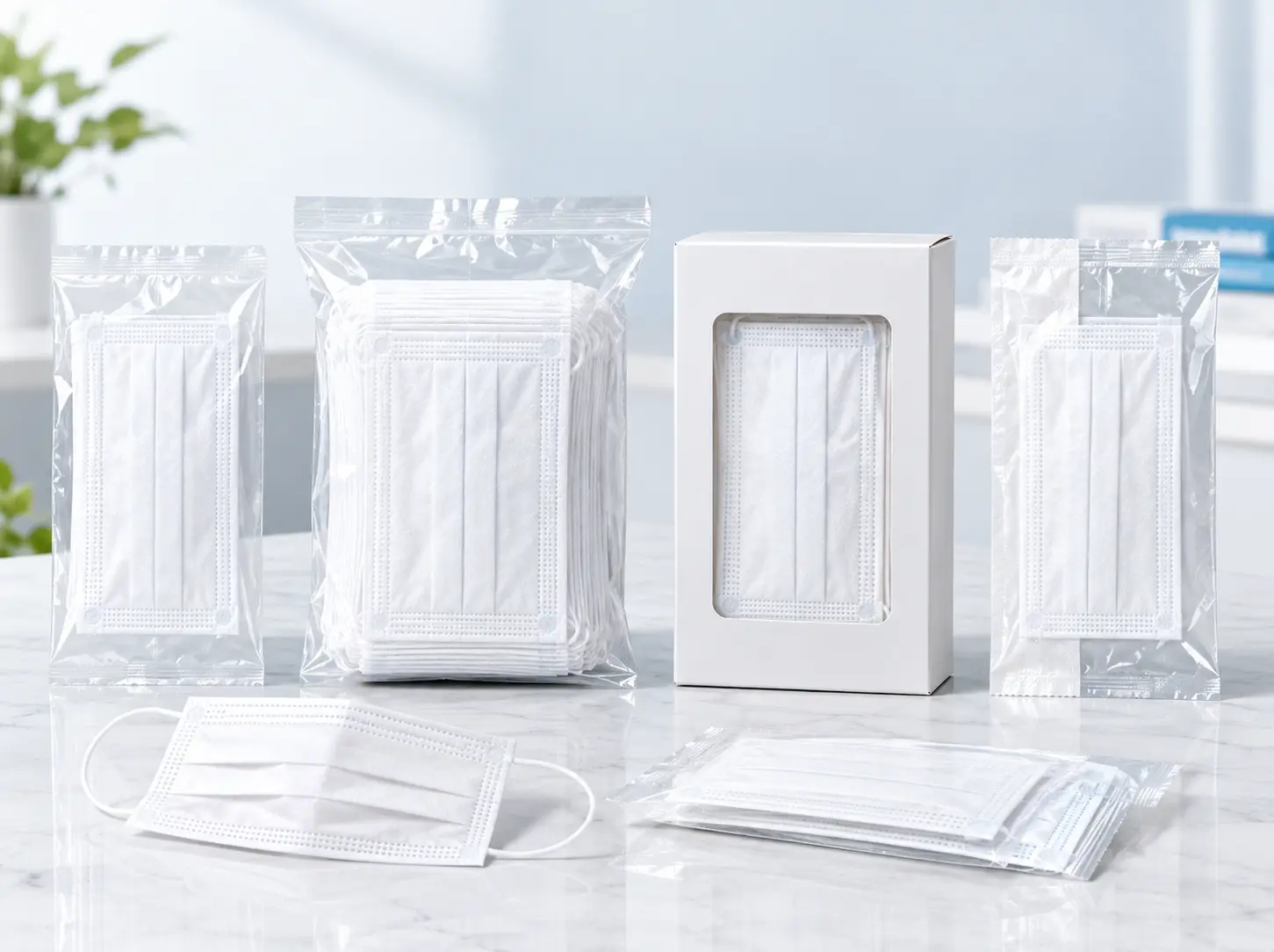
Bulk Soft Bags: Cost-Effective Disposable Face Mask Packaging
The familiar 50-piece or 100-piece bag is the bulk format. Dozens of masks share one laminated film bag. There is no individual separation. Production is fast. Material cost is low. That makes it ideal for households, factories and offices. But there is a clear weakness. Once opened, all remaining masks face the air. Frequent opening brings humidity and dust. The remaining masks absorb them easily. Use an opened bag quickly. Do not store it long-term. In export orders, this bag often serves as the middle layer. Cartons hold the bags for shipment.
Paper Boxes: Display-Focused Disposable Face Mask Packaging
Paper boxes are another common choice. They are usually white cardboard. Some are laminated with glossy or matte BOPP film. Two variants exist. Window boxes show the masks inside. They work well for retail display. Closed boxes offer stronger protection. Hospitals and companies prefer them. Slide-out openings make mask removal easy. Paper boxes resist moisture poorly. High humidity softens and deforms them. Keep storage areas dry. For sea freight, add desiccant bags inside.
Medical Paper-Plastic Pouches: Sterile Disposable Face Mask Packaging
Medical paper-plastic pouches serve sterilized surgical masks and medical protective masks. They combine medical-grade paper on one side and laminated film on the other. The paper is gas permeable. After sealing, ethylene oxide (EO) gas enters the pouch and sterilizes the masks. After sterilization, residual gas escapes through the paper. Bacteria cannot enter in reverse. The contents stay sterile over time.
Ordinary plastic bags cannot perform EO aeration. Sterilized medical masks must never be repacked in them. This is a critical point in medical mask packaging. For reference, see ASTM F2100-20 for medical face mask material requirements.
Corrugated Cartons: Outer Disposable Face Mask Packaging for Export
The outermost layer is the corrugated carton. It absorbs impact and compression during sea and road freight. Cartons carry printed product name, batch number, specification and storage conditions. This supports traceability. For export, carton grade must match destination requirements. Humid sea routes need moisture-resistant grades.
How to Choose the Right Disposable Face Mask Packaging
Different formats serve different channels. Individual sachets focus on retail and portability. Bulk soft bags target volume procurement at lower cost. Paper boxes balance display and protection. Paper-plastic pouches are for sterilized medical masks. Packaging film performance matters too. Heat-seal temperature, transparency and anti-static properties decide line efficiency and seal quality.
Buyers should verify the mask product standard first. Then check packaging integrity. A torn or unsealed pouch risks contamination. Do not use it, even if the mask looks untouched. Understanding disposable face mask packaging is the final step in respiratory protection.