
Whether quick-frozen dumplings stored at -18℃ keep their fresh taste and texture after six months in a cold warehouse depends largely on the unremarkable-looking frozen food laminated packaging film. It must withstand repeated flexing at deep-freeze temperatures, block oxygen and moisture vapor, and meet food-contact safety requirements — tasks that a single-layer plastic film can hardly accomplish all at once.
Why Frozen Food Needs a Dedicated Laminated Film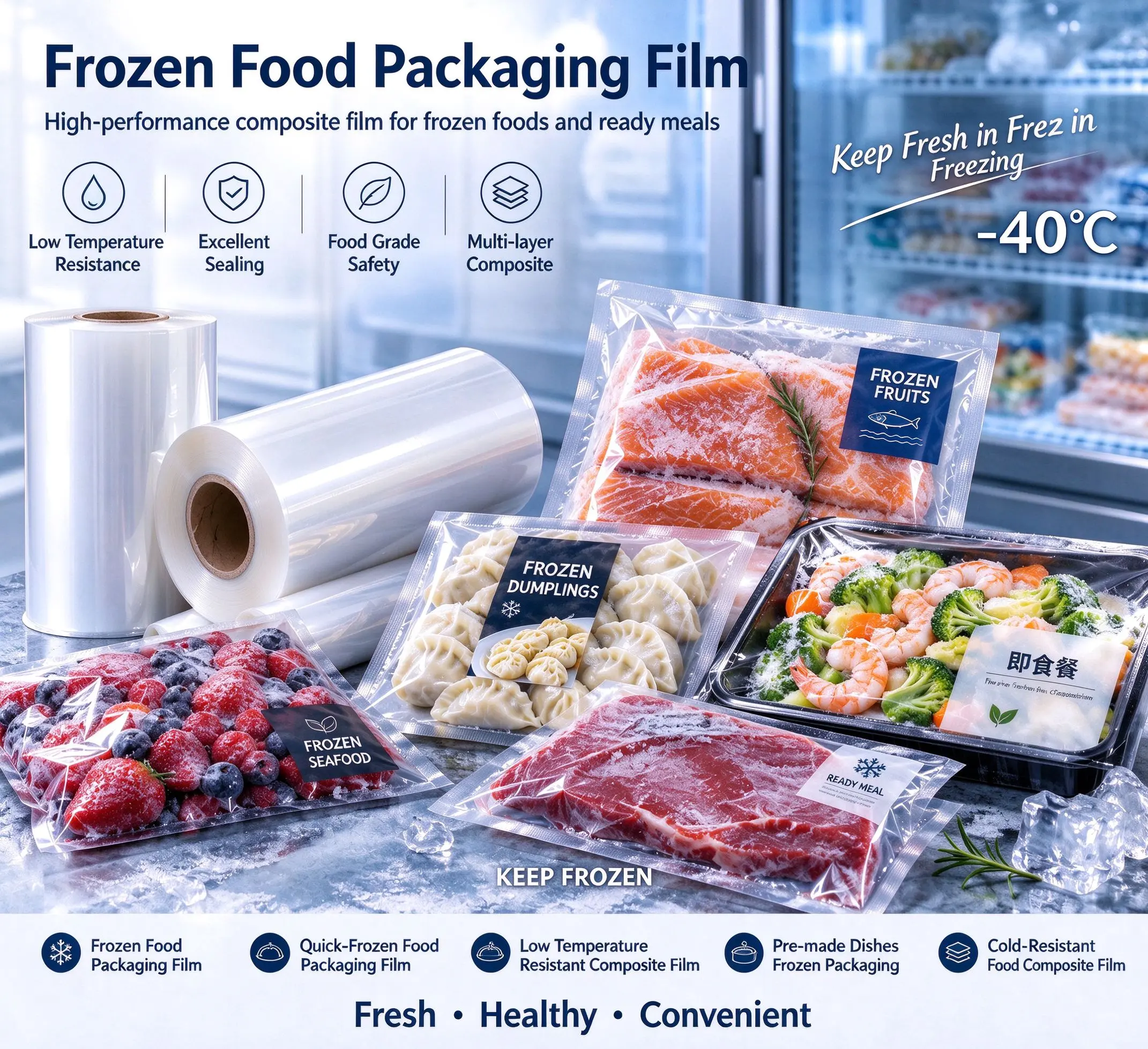
The Chinese national standard GB/T 24616-2019 defines frozen foods as foods stored, transported and sold at or below -18℃; the companion standard GB 31646-2018 requires quick-frozen food cold storage at no higher than -18℃ with temperature fluctuation kept within ±2℃. In such demanding low-temperature environments, ordinary single-layer polyethylene film turns visibly stiff and brittle, and shipping vibration or flexing can easily create pinholes in the film surface.
Once a pinhole or a weak seal lets air in, moisture at the food surface slowly sublimates away and fats oxidize, producing the dry white patches known as freezer burn — the most common quality killer in frozen food. A laminated film solves this by combining several materials so that low-temperature toughness, puncture resistance, oxygen and moisture barrier, heat sealability and printability are achieved together, even though no single material can deliver all of them.
Structure and Function of Laminated Film for Frozen Food
Frozen food laminated packaging film typically uses a sandwich structure of outer layer — barrier layer — sealant layer, bonding films with different properties into one web through dry lamination, solvent-free lamination or co-extrusion, so that each layer does only what it does best.
Outer Layer: Printing and Mechanical Protection
The outer layer is usually PET polyester or biaxially oriented polyamide (BOPA). It carries the brand printing, provides film stiffness and scuff resistance, and keeps the barrier layer underneath from being scratched or damaged during bag making, filling and handling.
Middle Layer: Oxygen and Moisture Barrier Core
The middle barrier layer is the freshness gate of the whole film. For long-shelf-life frozen ready meals and meat, EVOH high-barrier resin is often used to cut oxygen transmission to a fraction of ordinary polyethylene; for products that also need to be protected from light, such as ice cream, an aluminum foil layer provides near-total barrier. EVOH loses barrier performance in humid conditions, so it must be sandwiched between moisture-resistant layers.
Inner Layer: Food-Contact Heat-Seal Layer
The inner layer touches the food directly and is typically metallocene linear low-density polyethylene (mLLDPE). It keeps its flexibility even at -40℃, forms strong and stable heat seals, suits high-speed automatic bag making, and complies with food-contact material standards.
Common Material Combinations Compared
Different frozen foods place very different demands on packaging, so selection starts with the structure. Here are the three most common laminated film combinations for frozen food:
| Structure | Typical Applications | Key Strengths | Reference O₂TR |
|---|---|---|---|
| PA/PE | Frozen poultry, bone-in meat, seafood vacuum packs | Puncture resistance, low-temperature impact strength, transparency | ~30–50 cm³/(m²·24h·atm) |
| PET/AL/PE | Ice cream, frozen desserts, light-sensitive items | Full barrier to light, oxygen and moisture | Near 0 |
| PA/EVOH/PE | Long-shelf-life ready meals, frozen steak | Ultra-high barrier, flavor and aroma retention | Far lower than PA/PE |
Note: O₂TR values above are typical industry references measured at room temperature; always verify actual values against the supplier’s test report. For more technical detail, see the multi-layer co-extruded high-barrier film guide.
How to Select Frozen Food Packaging Film
When sourcing frozen food laminated packaging film, evaluate four dimensions:
- Product characteristics: bone-in meat calls for stronger puncture resistance (PA layer); long-shelf-life products need a higher barrier grade;
- Cold chain temperature: for -40℃ deep-freeze transport, confirm the film’s low-temperature rating and mLLDPE content;
- Bag-making process: match the heat-seal temperature window of automated packaging lines to avoid weak seals;
- Compliance: request food-contact material (GB 4806.7) test reports and verify that inks and adhesives are compliant.
Frequently Asked Questions
Why does frozen food get “freezer burn” and how can it be avoided?
Which film is suitable for -40℃ deep-freeze environments?
What is the difference between a laminated film and a single-layer film?
Is frozen food laminated packaging film food-safe?
Conclusion
Frozen food laminated packaging film is the first line of defense for quick-frozen food quality: layered structure for divided labor, cold-resistant materials for barrier performance, and process compatibility for automation and safety. Understanding how it works helps you make more rational choices. For further reference, browse barrier packaging selection for frozen food.