
Grab a ruler — this 3-step guide shows you exactly which sides to measure, and how those three numbers turn into your finished film size.
Why measuring matters
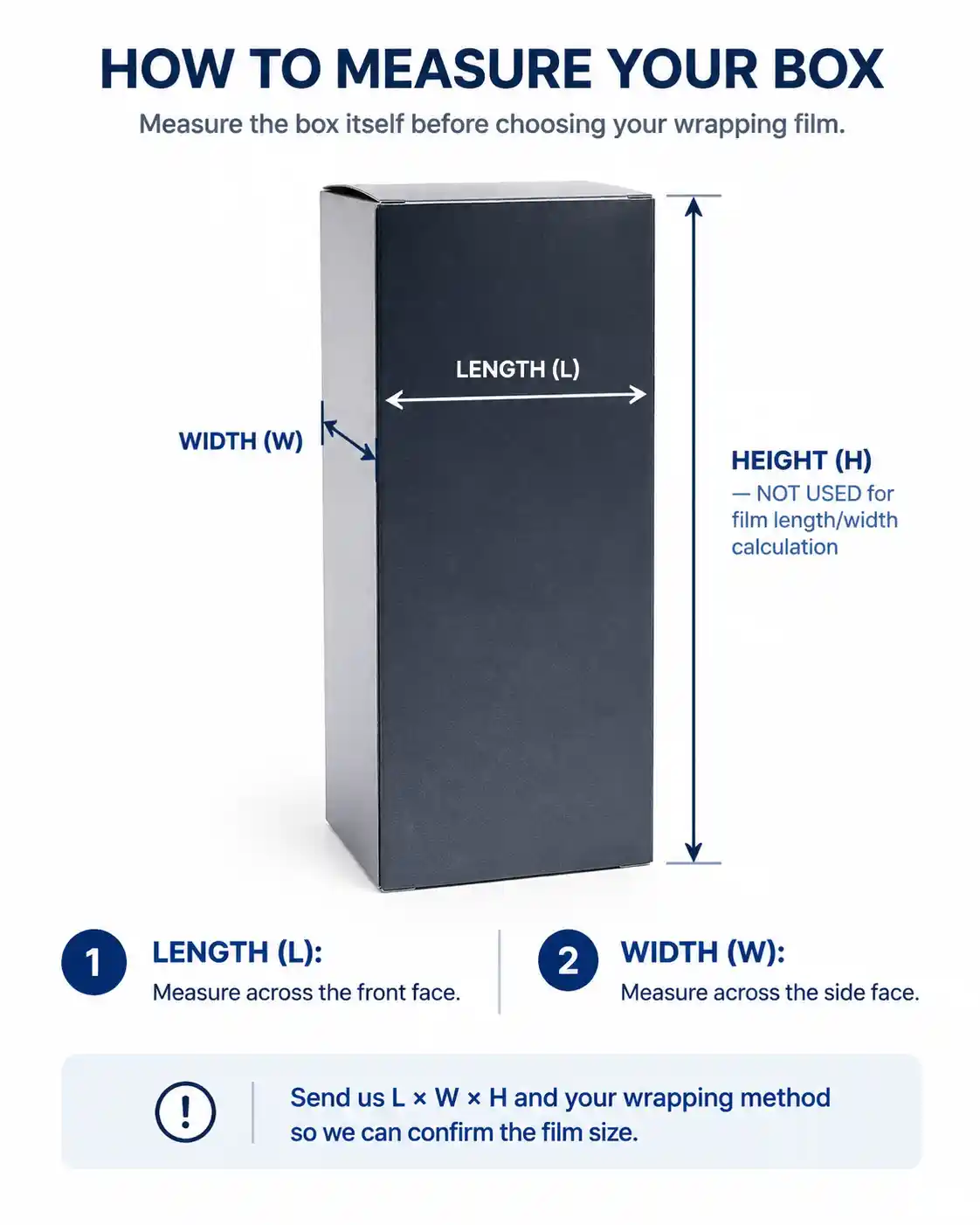
To order the right wrapping film, measure three numbers on your closed box — length (front face), width (side face) and height — then add the allowances in our formula to get your finished film size.
If you’ve ever ordered wrapping film and ended up with a wrap that’s too tight or too loose, the problem is usually not the film. It’s the measurements. Film is cut to the box’s real dimensions, so even a 2 mm slip at the start gives you a sleeve that doesn’t sit right after shrinking. The good news is that measuring takes about two minutes and needs no special tools.
What you need
- A ruler or tape measure marked in millimeters
- Your box, closed and empty
- A flat, hard surface
- A pen to write down the three numbers (optional but recommended)
Step 1: Measure the length — the front cross-section
Place the box in front of you so you’re looking straight at the front face. The length is the horizontal distance across the front face of the box — the long side of the front cross-section. Measure along its bottom edge in millimeters and write it down as L.
Step 2: Measure the width — the side cross-section
Turn the box 90 degrees so the side face is facing you. The width is the horizontal distance across the side face of the box — the short side of the side cross-section. Measure along its bottom edge and write it down as W.
Step 3: Measure the height
Keep the box standing. The height is the vertical distance from the bottom to the top of the box, measured along one corner. Write it down as H.
Quick check: L should be your biggest number and W your smallest. If they look backwards, swap them — it changes the film size.
How to confirm your film size
Here is the formula we use to cut film for a box:
- Film length = L + 30 mm + 20 mm
- Film width = (W x 2) + (H x 2) + 20 mm
Read that second line carefully — the film wraps around the width and the height of the box, so both sides of the cross-section count twice. The 30 mm on the first line is the end-seal allowance. The 20 mm is a working allowance you can fine-tune: keep it at least half of the box height, and no more than the full height. If your box is soft or your film is thick, lean toward the higher end.
Worked example
Say your box measures L 150 mm, W 80 mm, H 30 mm:
- Film length = 150 + 30 + 20 = 200 mm
- Film width = (80 x 2) + (30 x 2) + 20 = 240 mm
So the finished film size is 200 x 240 mm. Put your own three numbers into the formula and you’ll get the same kind of answer.
Tips for accurate measuring
- Measure in millimeters — it keeps the formula clean.
- Close the box before measuring. An open or collapsed box gives numbers that are simply wrong.
- Measure on a flat surface, not in your hands.
- Run the ruler along the edge, not across the middle of the panel — cardboard panels can bow.
- Measure twice. If the two readings differ, use the larger one.
Send us your measurements
Please send us the box dimensions in L × W × H (mm or cm), along with a photo of the box and your wrapping method (manual or machine wrapping). Our team will help you confirm the correct film size for your packaging needs.
Note: The required film dimensions depend on the box size, wrapping method, sealing overlap, and equipment. Please confirm the final film size with us before ordering.
Looking for more? See choosing the right shrink film thickness and our shrink film vs stretch film — which one do you need. For the basics of how the material works, this overview of shrink film explains the shrinking process in plain terms.