In recent years, green packaging, plastic reduction, and low-carbon development have become mainstream themes across the packaging industry.
Paper packaging, degradable films, and bio-based materials keep growing in popularity. Countless brands are upgrading their packaging solutions to meet global environmental policies. Yet one striking industry trend remains. Transparent OPP film packaging has not faded from the market. It still dominates key sectors: apparel, flowers, creative goods, e-commerce retail, and daily consumer products.
Many purchasers, brand owners, and manufacturers share the same question. Is OPP packaging truly eco-friendly? Will strict global sustainability rules phase it out completely over the next 3–5 years?
We set aside marketing hype and one-sided opinions. This article breaks down the unique value of OPP packaging and its future outlook, based on full life-cycle environmental logic and 2026’s latest global packaging regulations.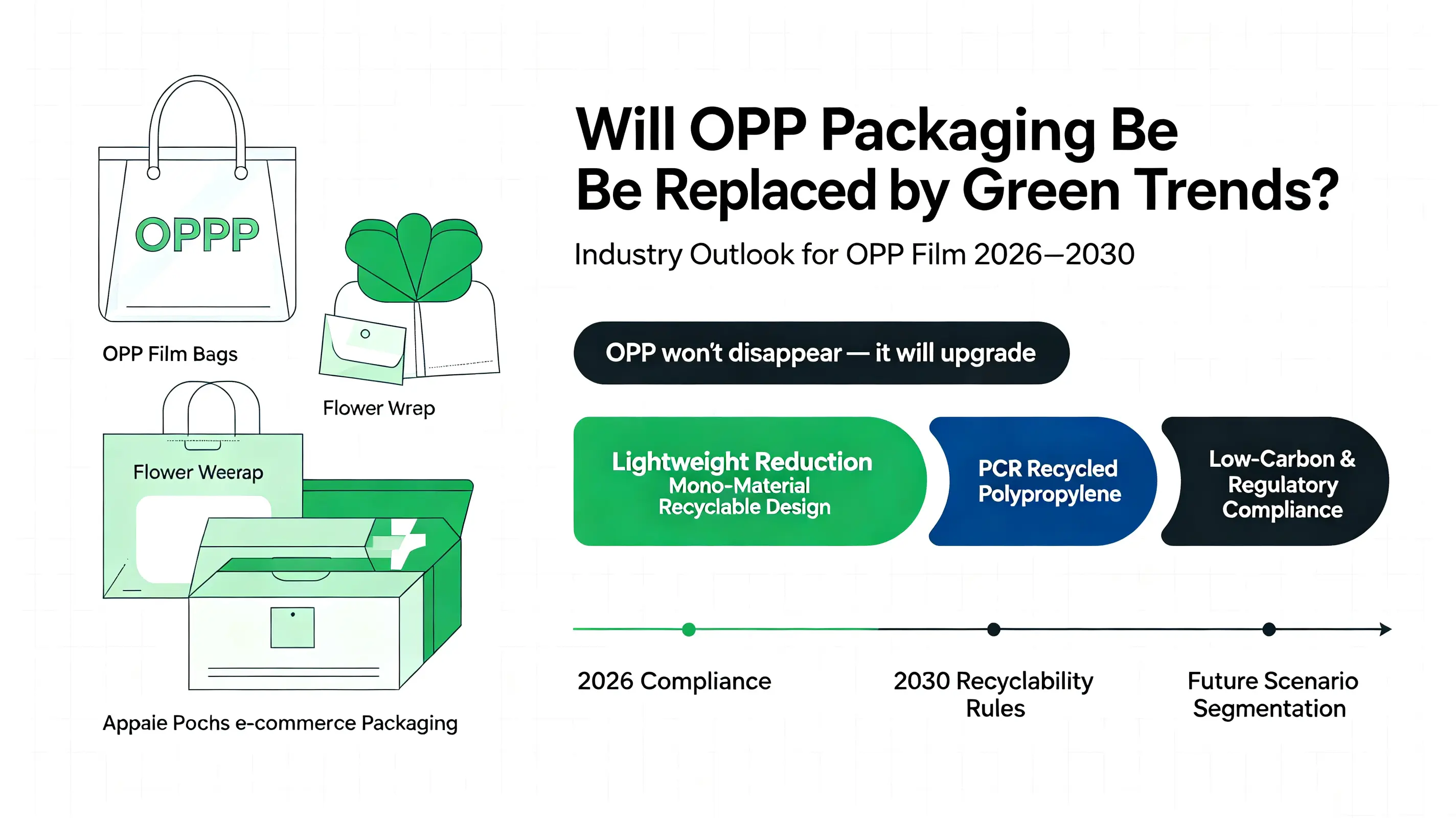
1. True Green Packaging Is Not Simply “Replacing Plastic with Paper”
Most consumers see eco-friendly packaging as “plastic-free packaging”. They assume paper or fully degradable materials are always better for the planet.
But industry standards and expert bodies judge sustainability differently. A material’s environmental impact does not depend on its name. It depends on full life-cycle metrics: carbon emissions, material use, product protection, transport energy use, and recyclability.
ISO 14067 is the global standard for product carbon footprint accounting. It uses Life Cycle Assessment (LCA) to measure greenhouse gas emissions across a product’s full life. This covers raw material production, processing, transport, use, and waste disposal. This scientific framework is widely recognized and promoted by the World Packaging Organisation (WPO) to standardize sustainable packaging evaluation worldwide.
In short, green packaging answers five core questions:
- Is material use minimized?
- Is the packaging recyclable?
- Does it cut product damage?
- Does it reduce transport weight?
- Can it fit into circular recycling systems?
This is why OPP packaging stays strong amid green trends. It is not a perfect material, but it offers the best overall balance of cost, practicality, low-carbon performance, and regulatory compliance.
2. Why OPP Packaging Remains Indispensable
Superior Transparency for Retail Display
For retail products, packaging does more than protect goods. It also acts as a visual marketing tool.
Flowers, clothing, gifts, books, stationery, and e-commerce items all need transparent packaging. It shows off product texture, color, and fine details — a key driver of consumer purchase intent.
Traditional paper packaging hides products from view. Degradable films often look foggy, flat, and low-gloss, which makes products seem cheaper. OPP film is different. It offers high clarity, excellent gloss, good stiffness, and sharp print quality. It showcases products perfectly while adding dust and moisture protection. This makes it irreplaceable for retail display.
Lightweight, Material-Saving, Low-Carbon Benefits
One of OPP’s most underrated eco strengths is its ultra-lightweight design and low material use.
Thanks to mature manufacturing technology, OPP films can be made very thin while keeping their strength and protective performance. Factories produce tens of thousands of packages every day. Even a tiny material saving per unit adds up to big raw material savings and lower carbon emissions.
Lightweight packaging also cuts overall shipping weight. This directly reduces logistics energy use and transport carbon footprints. The core rule is clear: lightweight does not mean lower quality. It means maximum material efficiency without losing functionality.
Mature System for Automated Mass Production
Most new eco-materials work well in concept, but lack real industrial adaptability.
OPP has a fully mature global supply chain. It covers film production, printing, bag making, and automated packaging. It delivers excellent stability, consistent batch quality, and broad equipment compatibility. It supports high-speed automated lines, steady color printing, reliable heat sealing, and predictable costs.
For big brands and large manufacturers, packaging must balance green goals with stable mass production, low damage rates, and strict quality control. This is why new alternatives cannot fully replace OPP any time soon.
Single Pure Material With Built-In Recyclability
A common myth is that OPP is non-recyclable single-use plastic.
In reality, OPP is a pure polypropylene (PP) film. It has no composite layers, coatings, or mixed materials. That means it is fully recyclable. It can be reprocessed and reused after collection.
By contrast, many “eco-friendly” paper packages use PE coating for moisture and oil resistance. This creates paper-plastic composites that cannot be separated or recycled. These fake eco-friendly options end up in landfills or incinerators. They produce far higher carbon emissions than pure OPP film.
Sustainable packaging focuses on circular recycling and material reduction, not blind plastic bans. A material’s natural recyclability defines its long-term environmental value.
3. Key Truth: Recyclable Does Not Mean Actually Recycled
It is important to tell the difference between theoretical recyclability and real-world recycling rates.
Pure OPP film has great recycling potential. But its actual recycling rate depends on local systems: waste sorting, soft plastic recycling facilities, sorting technology, and reprocessing capacity.
Future packaging industry competition is no longer just about material substitution. It is a competition of recycling systems and circular design capability.
Global environmental rules are getting stricter, especially the new EU EPR and PPWR packaging policies. They have pushed packaging design into a new era of “design for recycling”.
4. OPP Packaging Trends 2026–2030
OPP packaging will not disappear between 2026 and 2030. Instead, it will go through full, refined upgrading. Old, heavy, wasteful, hard-to-recycle OPP products will slowly phase out. They will be replaced by low-carbon, recyclable, fully compliant next-generation OPP packaging.
The whole industry is shifting from extensive production to low-carbon, regulation-focused circular development. Lightweight material reduction will become the basic industry standard. Manufacturers will use better resin formulas and stretching processes to make film thinner without losing protection. This delivers both cost savings and carbon reduction.
At the same time, recyclable single-material design has become a required regulatory standard. In response to EU PPWR rules, single-layer pure OPP (no composite coatings) will lead the market. Hard-to-recycle composite packaging will gradually disappear. The smart use of PCR (Post-Consumer Recycled) polypropylene has become a key advantage for cross-border exports and high-end brand orders. Companies will adjust recycled material ratios based on use case and safety standards. This lets them upgrade to low-carbon solutions compliantly and avoid greenwashing risks.
The industry will see clear scenario-based segmentation. Different materials will serve different needs. Degradable films and paper packaging will spread to low-value disposable use cases. Upgraded recyclable OPP will stay the best choice for retail display, automated mass production, premium fine packaging, and cross-border trade. Future competition will no longer focus on simple price or thickness advantages. It will focus on overall strengths: full-life low-carbon performance, regulatory compliance, and circular sustainability.
5. Conclusion: OPP Will Not Disappear — Outdated OPP Will
The point of green packaging is not to get rid of all plastic materials. It is to use fewer resources for equal or better protection, and keep materials in circulation to cut environmental harm.
From 2026 to 2030, the upgrade path for OPP packaging is clear: lightweight design, single-material structure, recyclability, low-carbon PCR use, and full global compliance.
Instead of asking if OPP will be killed by environmental trends, the industry should ask a better question. How do we build next-generation OPP packaging that is thinner, lighter, more recyclable, and fully regulation-compliant? This will be the core long-term competitiveness of the packaging industry over the next five years.
For custom sustainable OPP film solutions and full packaging support, explore our complete product range.