
Flexible Film Market Changes in 2026: PPWR Rules, Price Hikes and Mono-Material Innovation
The global flexible packaging film industry is undergoing a profound structural overhaul in 2026. Multiple key factors are driving this widespread industry transformation. First and foremost, the EU PPWR policy will enter full mandatory enforcement. Secondly, global raw material markets face persistent and drastic price swings. Thirdly, green packaging technologies keep achieving iterative breakthroughs. Specifically, EU strict environmental regulations have rewritten market access rules for imported packaging films. At the same time, soaring raw material costs have forced enterprises to adjust profit layouts and product structures. Furthermore, leading global chemical and packaging companies keep investing in mono-material film R&D. Thanks to these technological efforts, the industry is moving steadily toward recyclable, low-carbon and sustainable development. This report comprehensively covers policy updates, price dynamics, technical innovations and future trends of the global flexible film sector.
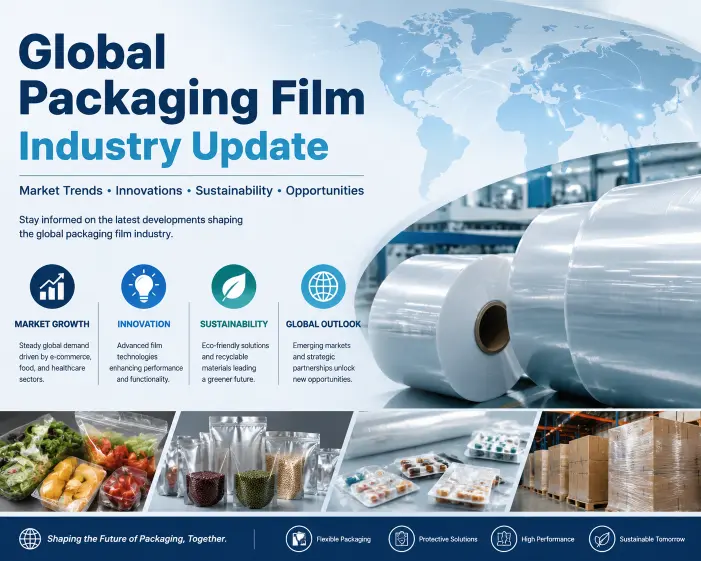
1. Full PPWR Enforcement Reshapes Global Flexible Film Trade Pattern
The EU’s landmark PPWR will take full mandatory effect on August 12, 2026. It will implement unified, zero-tolerance compliance standards for all imported packaging film products. In preparation for the official enforcement, major European ports have launched advance compliance screenings. For instance, Rotterdam and Hamburg have tightened inspection procedures for incoming film shipments. As a direct consequence, non-compliant multi-layer composite film cargoes will face harsh punitive measures. These measures include port detention, mandatory return and complete product destruction. Ultimately, these stringent regulatory rules have built high trade barriers for traditional film exporters targeting the EU market.
The new PPWR regulation defines three core mandatory requirements for the film industry. To begin with, it imposes a full ban on PFAS substances in all food-contact packaging films. This restriction eliminates harmful chemical residues and safeguards food and environmental safety. In addition, it sets a clear recycled content standard for plastic film production. By 2030, all commercial plastic films must contain at least 30% recycled materials, which accelerates the development of industrial circular economies. Lastly, it will gradually phase out complex multi-layer laminated packaging with non-recyclable structures.
Traditional multi-layer aluminum-plastic composite films once occupied a dominant market position. They were widely applied in food, daily chemical and cold-chain packaging fields. Their popularity mainly stemmed from excellent barrier and protective properties. Nevertheless, their inherent structural flaws limit their future development. These composite structures cannot be separated or recycled after use. For this reason, they have lost qualification for EU market entry. On the contrary, recyclable mono-material films serve as the most stable and compliant alternative. Accordingly, such eco-friendly films have become a basic requirement for EU export enterprises.
2. Raw Material and Geopolitical Pressures Trigger Sharp European Film Price Hikes
European flexible packaging film substrates experienced a sharp price surge in the second quarter of 2026. Flexible Packaging Europe has released official data to verify this market uptrend. In reality, the price hike results from a combination of multiple negative factors. First of all, international crude oil prices maintained a continuous upward trend. Meanwhile, core chemical raw materials such as PTA and MEG suffered frequent cost fluctuations. Apart from raw material pressures, global supply chain instability further exacerbated market price volatility.
Specifically, the mainstream 12μm BOPET film price jumped nearly 40% quarter-on-quarter in Q2 2026. Similarly, HDPE and BOPP film prices achieved obvious double-digit growth rates. The price increase covered the entire flexible packaging substrate industry. Beyond cost factors, steady downstream demand supports high market prices. Starting from July, European terminal packaging demand has achieved stable recovery. This covers food, daily chemical and cold-chain packaging sectors. As a result, overall film prices have remained at a relatively high level.
Currently, European packaging processing enterprises are bearing dual operational pressures. On one side, continuous raw material inflation erodes corporate profit margins. On the other side, PPWR regulatory upgrades raise industry compliance thresholds. Consequently, manufacturers across the industrial chain have taken proactive optimization measures. They are gradually phasing out low-margin, non-recyclable traditional composite products. At the same time, they are transferring production capacity to high-value, regulation-compliant eco-friendly films. This strategic adjustment helps enterprises adapt to the updated market and regulatory environment.
3. Global Industry Leaders Speed up Mono-Material Film Innovation for PPWR Compliance
To adapt to the new PPWR regulatory system and seize emerging market dividends, global industry leaders have accelerated technological innovation paces. In recent years, top chemical and packaging giants have increased R&D investment significantly. Their core research focus lies in high-performance recyclable mono-material films. As a result, a batch of practical and innovative new products has been launched. These new products effectively replace backward, non-recyclable composite film solutions.
At the 2026 Interpack exhibition, LG Chemistry officially unveiled its UNIQABLE™ ultra-thin mono-material film. This innovative product features a 12–14μm ultra-thin design and abandons traditional aluminum-plastic composite structures. Most importantly, it realizes full recyclability without sacrificing core barrier performance. It can stably resist oxygen and moisture erosion in daily packaging scenarios. In brief, it balances protective performance and environmental compliance perfectly. It also provides a lightweight, eco-friendly option for food and consumer goods packaging.
Besides LG Chemistry’s technological breakthroughs, ExxonMobil has also made remarkable progress. It has partnered with LD PACK to develop advanced MDO-based mono-PE freezer films. This new product is professionally customized for frozen food packaging scenarios. In general, ordinary recyclable films fail to perform well in low-temperature environments. Conversely, this customized mono-PE film delivers excellent cold resistance and complete recyclability. For this reason, it fully meets the strict performance and compliance standards of the European cold-chain packaging market.
Meanwhile, Firsta Group has released its new ILC-BOPP mono-material barrier film. Unlike ordinary processed packaging films, this product adopts full-process integrated production modes. The production process covers masterbatch customization and precision surface coating. This complete industrial system guarantees stable and consistent product quality in batches. Therefore, the film can fully meet the high-standard compliance and quality requirements of EU export-grade packaging.
4. 2026 Global Flexible Film Industry Outlook
2026 serves as a pivotal transformation year for the global packaging film industry. In fact, two core driving forces are reshaping the industrial competition landscape. Firstly, policy-led green upgrading continues to lift global environmental access standards. Secondly, unstable raw material prices push forward structural market adjustments. Overall, the whole industry is eliminating backward production capacity and expanding high-end eco-friendly product layouts.https://www.packagingeurope.com
In the long-term industrial perspective, three categories of eco-friendly films will maintain rapid growth trends. These include recyclable mono-material films, PFAS-free eco-films and biodegradable films. Gradually, these innovative green products will replace traditional multi-layer composite films. They will eventually dominate the global flexible packaging market. Hence, enterprises with independent R&D capabilities of compliant eco-films will gain prominent competitive edges. In contrast, outdated non-recyclable composite film capacity will be continuously eliminated. Ultimately, this industrial upgrade will drive the entire sector toward high-quality, green and circular sustainable development.
》》》》 Get Instant Packaging Film Support & Custom Quotation For customized film specifications, bulk wholesale prices, and fast delivery arrangements, feel free to contact us via WhatsApp: +86 139 0411 3069. We provide professional one-stop flexible packaging solutions for global importers worldwide.
》》》》 Learn More About Our Services Visit our official homepage: https://ahswpackaging.com/ to explore our full product range, industrial chain advantages and one-stop packaging supply solutions.