
Explore the practical BOPP film applications across commercial and industrial fields. This guide covers core uses, unique advantages, and industry scenarios of biaxially oriented polypropylene film for modern packaging solutions.
Biaxially Oriented Polypropylene (BOPP) film is a mainstream flexible packaging material in the global market. Thanks to refined biaxial stretching technology, the material boasts a stable molecular structure, excellent toughness, high transparency, and superior barrier properties.
It is non-toxic, eco-friendly, and highly adaptable to printing, lamination, and composite processing. These outstanding physical and chemical traits make its application scenarios extremely diverse, covering food packaging, product finishing, label printing, adhesive manufacturing, and industrial protection.
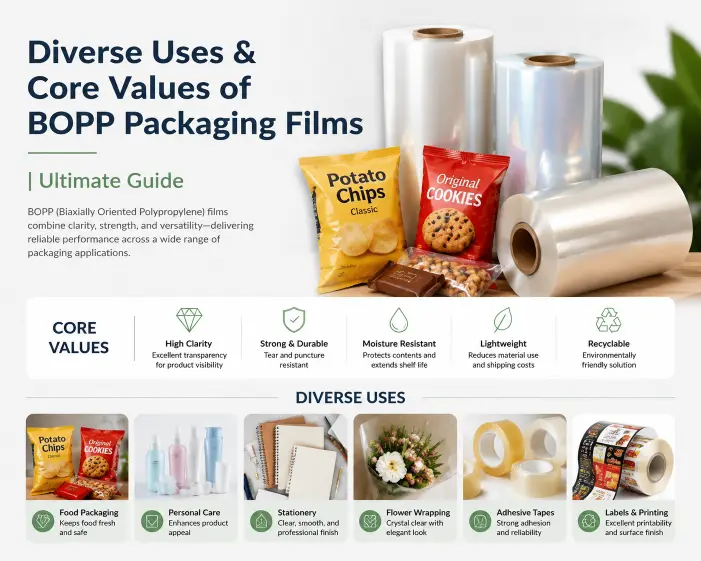
1. Food Packaging Applications: Freshness Protection & Safe Sealing
One of the most mature BOPP film applications lies in the food and beverage packaging industry. Food products require strict moisture-proof, oxygen-isolating, and anti-pollution packaging conditions to extend shelf life.
Standard transparent grades act as ideal outer packaging for dry foods, including bread, cookies, nuts, and grains. The high-light transmittance presents product details intuitively, improving consumer visual experience.
Heat-sealable variants adapt to high-speed automated packaging lines. They are widely used for snacks, candies, and instant food, providing tight, leak-proof, and durable sealing effects for mass production.
High-barrier modified types effectively block ultraviolet rays and air oxidation. They preserve the flavor and nutrition of premium foods such as tea, coffee powder, and milk powder, fully complying with global food-grade safety standards.
2. Luxury Lamination Applications: High-End Product Surface Finishing
High-gloss and matte BOPP materials are widely applied in high-end product lamination, which is a vital commercial segment of BOPP film applications.
The film features low haze, excellent flatness, and strong scratch resistance. After lamination on paper boxes, it effectively prevents surface scratching, yellowing, and deformation during transportation and storage.
Special shrinkable grades are commonly used for cigarette box outer wrapping. They achieve uniform thermal shrinkage and tight fitting, bringing neat and high-grade packaging effects for branded products.
Besides tobacco packaging, the lamination technology is extensively used for cosmetic gift boxes, pharmaceutical packaging boxes, and luxury product packaging. It balances protective performance and brand aesthetic display perfectly.
3. Printing & Label Applications: High-Precision Graphic Substrate
Printing and labeling is another core field of BOPP film applications. The biaxial stretching process forms an ultra-flat film surface with stable tension, laying a foundation for high-precision printing.
After professional corona treatment, the film surface gains strong ink adhesion. Printed patterns and texts are vivid, clear, and fade-resistant, without blurring or peeling off in long-term use.
The material can be processed into various functional labels, including self-adhesive stickers, in-mold labels, and bottle labels for beverages and daily chemical products.
It features excellent water-proof, oil-proof, and UV-resistant performance. Different from traditional paper labels, BOPP labels remain flat and firm in humid and high-temperature environments, with no warping or falling off.
Matte film variants can create low-gloss and delicate visual effects, meeting the personalized packaging design needs of minimalist and light-luxury brands.
4. Adhesive Tape Applications: Industrial Base Film Production
Industrial tape manufacturing is a large-scale industrial scenario for BOPP film applications. The film serves as the core base material for various adhesive tapes.
With uniform texture, high tensile strength, and excellent toughness, the film is not easy to break or deform. Its smooth surface supports even glue coating and stable bonding performance.
Finished BOPP tapes feature stable viscosity, strong tensile resistance, and reliable peeling resistance. They are suitable for logistics carton sealing, industrial fixing, and daily office bonding scenarios.
The material is lightweight, cost-effective, and compatible with automated mass production. It has become an irreplaceable base material in the global adhesive industry chain.
5. Composite & Industrial Applications: Multi-Scenario Functional Uses
Diversified composite processing expands the boundary of BOPP film applications. The material has great compatibility with aluminum foil, PE film, cellophane, and paper materials.
Composite processed products integrate multiple material advantages, with greatly improved high-temperature resistance, impact resistance, and barrier performance. They are suitable for vacuum meat, cooked food, frozen products, and industrial chemical packaging.
In non-packaging fields, transparent BOPP film is used for dust-proof protection of textiles, garments, and home textiles. It protects product integrity without blocking the original appearance.
It is also widely used for book and album lamination, providing waterproof, anti-crease, and anti-fouling protection to extend the service life of paper products.
Pearlescent and metallized modified films are applied to gift decoration and color printing packaging, adding unique luster and texture to high-grade customized packages.
6. Why BOPP Film Is Widely Used in Modern Industries
The popularity of BOPP film applications stems from its comprehensive performance advantages and high cost-performance ratio.
Compared with PET and PE films, it achieves a perfect balance of optical aesthetics, mechanical strength, and production cost. It supports personalized modification, including barrier enhancement, matting, and metallization.
As the packaging industry develops toward lightweight, eco-friendly, and functional upgrading, BOPP film technology keeps iterating. New biodegradable and high-strength ultra-thin types further enrich application scenarios.
From civilian daily packaging to professional industrial manufacturing, BOPP film continues to provide stable, reliable, and cost-effective solutions for global packaging and material industries.
With flexible customization and durable performance, it remains one of the most valuable flexible film materials for various commercial and industrial Custom packaging film are available to match different BOPP film application needs. Refer to PET for material performance comparison.
According Plastics Industry Association, modified polypropylene films maintain dominant market shares in global flexible packaging fields.
》》》》 Get Instant Packaging Film Support & Custom Quotation For customized film specifications, bulk wholesale prices, and fast delivery arrangements, feel free to contact us via WhatsApp: +86 139 0411 3069. We provide professional one-stop flexible packaging solutions for global importers worldwide.
》》》》 Learn More About Our Services Visit our official homepage: https://ahswpackaging.com/ to explore our full product range, industrial chain advantages and one-stop packaging supply solutions.

1人评论了“BOPP Film Applications: Comprehensive Uses & Industry Benefits”
Nice answer back in return of this difficulty with solid
arguments and telling everything concerning that.