Mono-Material Polyolefin Film for EU PPWR: PE vs PP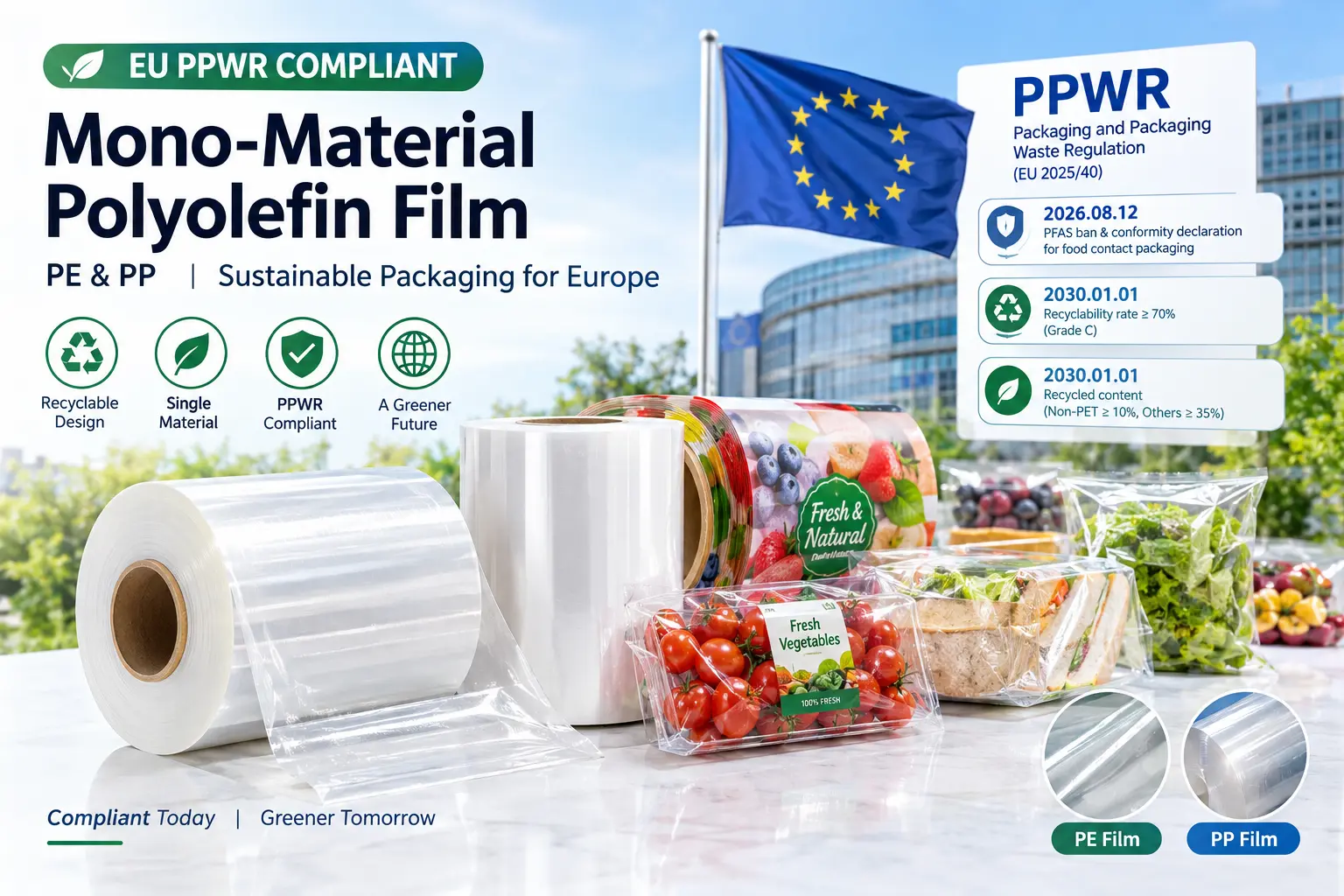
European packaging legislation has entered a new phase, and flexible film suppliers are feeling it directly. Since 12 August 2026, the Packaging and Packaging Waste Regulation (PPWR, Regulation (EU) 2025/40) has been applying across EU member states, setting strict conditions on how plastic packaging is designed, collected and recycled.
For film producers and converters serving European buyers, the practical question is no longer whether to adapt, but how fast. Traditional multi-layer laminates that combine PET, nylon or aluminium with PE are increasingly difficult to justify under the new rules. Instead, mono-material polyolefin film — built entirely from PE or PP — has become the reference solution for compliant flexible packaging.
What PPWR Actually Requires from Plastic Film
Three milestones deserve special attention:
- From 12 August 2026 – food-contact packaging containing PFAS above the specified thresholds can no longer be placed on the EU market, and packaging products require a declaration of conformity.
- From 1 January 2030 – packaging below recyclability performance grade C, meaning less than 70% recyclability, is considered non-recyclable and will be banned from the EU market.
- Also from 2030 – minimum post-consumer recycled content becomes mandatory: 10% for contact-sensitive plastic packaging other than PET, and 35% for other plastic packaging.
Sorting infrastructure also shapes product design. Waste sorting plants rely on near-infrared (NIR) technology to separate film streams, which is why dark carbon-black pigments are being replaced with NIR-detectable masterbatches. Industry guidance from CEFLEX recommends keeping non-polyolefin impurities below 5% by weight so that film can be processed in existing polyolefin recycling streams.
PE Film vs PP Film: Practical Differences That Matter
Both polyethylene and polypropylene belong to the polyolefin family — thermoplastic, mechanically recyclable and compatible with existing recycling streams. But the two materials behave differently in production and in the field.
Polyethylene (LDPE, LLDPE, m-LLDPE)
PE film is soft and highly extensible, with a wide heat-sealing window and excellent hot-tack strength. These properties make it the natural choice for pallet stretch wrap, shrink hoods and heavy-duty FFS bags running on high-speed automatic lines.
Its continuous service temperature stays around 80–95°C, so PE is not suitable for retort or microwave applications. Stiffness is also lower than PP, and corona treatment is normally required before printing. On the recycling side, PE flexible film benefits from comparatively mature collection and reprocessing infrastructure across most EU member states, and well-designed mono-PE structures routinely achieve grade A or B recyclability assessments.
Polypropylene (BOPP, CPP)
PP film offers noticeably higher stiffness and better dimensional stability. After corona treatment, it delivers crisp print quality and high gloss, which is why BOPP remains a staple for retail food wrappers and confectionery packaging. Its heat resistance also extends beyond PE, with many grades suitable for microwave-safe applications.
The trade-offs are just as real. PP has a higher melting point and a narrower heat-sealing range, so sealing parameters on the customer’s packaging line need careful adjustment. At very low temperatures, PP film can become brittle. And within Europe, industrial-scale sorting and recycling of flexible PP film is still concentrated in a limited number of regions, mainly Germany, Austria and northern Italy. A mono-PP construction such as BOPP/CPP can score well in recyclability assessments on paper, but actual recovery capacity in many EU countries remains constrained.
Quick comparison
| Property | PE film (LDPE / LLDPE) | PP film (BOPP / CPP) |
|---|---|---|
| Stiffness | Soft, flexible, high elongation | Rigid, good flatness |
| Heat sealing | Wide window, strong hot tack | Narrow window, higher sealing temperature |
| Temperature resistance | ~95°C short term | 120°C+, microwave-compatible grades |
| Printing | Needs corona treatment | Excellent after corona treatment |
| EU recycling infrastructure | Mature in most member states | Limited to certain regions |
| Typical applications | Stretch wrap, shrink hood, FFS bags | Glossy printed food packaging, wrappers |
How Mono-Material Polyolefin Film Is Evolving
Faced with these requirements, film manufacturers are moving on four fronts at once.
- Structure redesign. Composite laminates based on PET, nylon or aluminium are being phased out. Where barrier properties are essential, suppliers are turning to thin vacuum-deposited coatings such as SiOx or AlOx instead of incompatible resin layers, keeping the film fully polyolefin-based.
- Recycled content integration. Food-grade post-consumer recycled PE and PP are gradually entering film formulations, helping customers prepare for the 2030 PCR targets while preserving mechanical properties.
- Auxiliary material optimisation. Water-based inks and recyclable-friendly adhesives are replacing solvent-based alternatives, and foreign polymer content is kept below 5%. NIR-detectable colour masterbatches replace black pigments in stretch and shrink films.
- Lightweighting. Thinner gauges that maintain strength reduce total plastic consumption per pack, supporting the EU’s overall packaging waste reduction targets.
Which Film Should You Choose for the EU Market?
There is no universal winner between PE and PP; the right answer depends on the application, the destination and your compliance timeline.
For pallet wrapping, shrink hoods and heavy-duty transport bags, mono-PE remains the lower-risk mainstream choice today, thanks to mature recycling infrastructure in most European countries.
For high-gloss printed retail packaging and microwave-safe formats, mono-PP structures offer clear performance advantages. Before committing, confirm that your buyer’s country has practical collection and recycling routes for PP film, and complete a recyclability assessment early.
The Takeaway
PPWR has turned recyclability from a nice-to-have into a market access condition. Suppliers who redesign around mono-material polyolefin film, integrate recycled content step by step and document compliance will keep their positions in the European market — while those who wait risk losing shelf access after 2030.