
📌 1. What Is BOPP Film?
BOPP film (Biaxially Oriented Polypropylene film) is a high-performance, cost-effective plastic film widely used in modern flexible packaging and industrial manufacturing. Produced by extruding polypropylene resin and stretching it longitudinally and transversely, the biaxial orientation process greatly improves the film’s dimensional stability, mechanical strength, and overall performance compared with regular PP film.
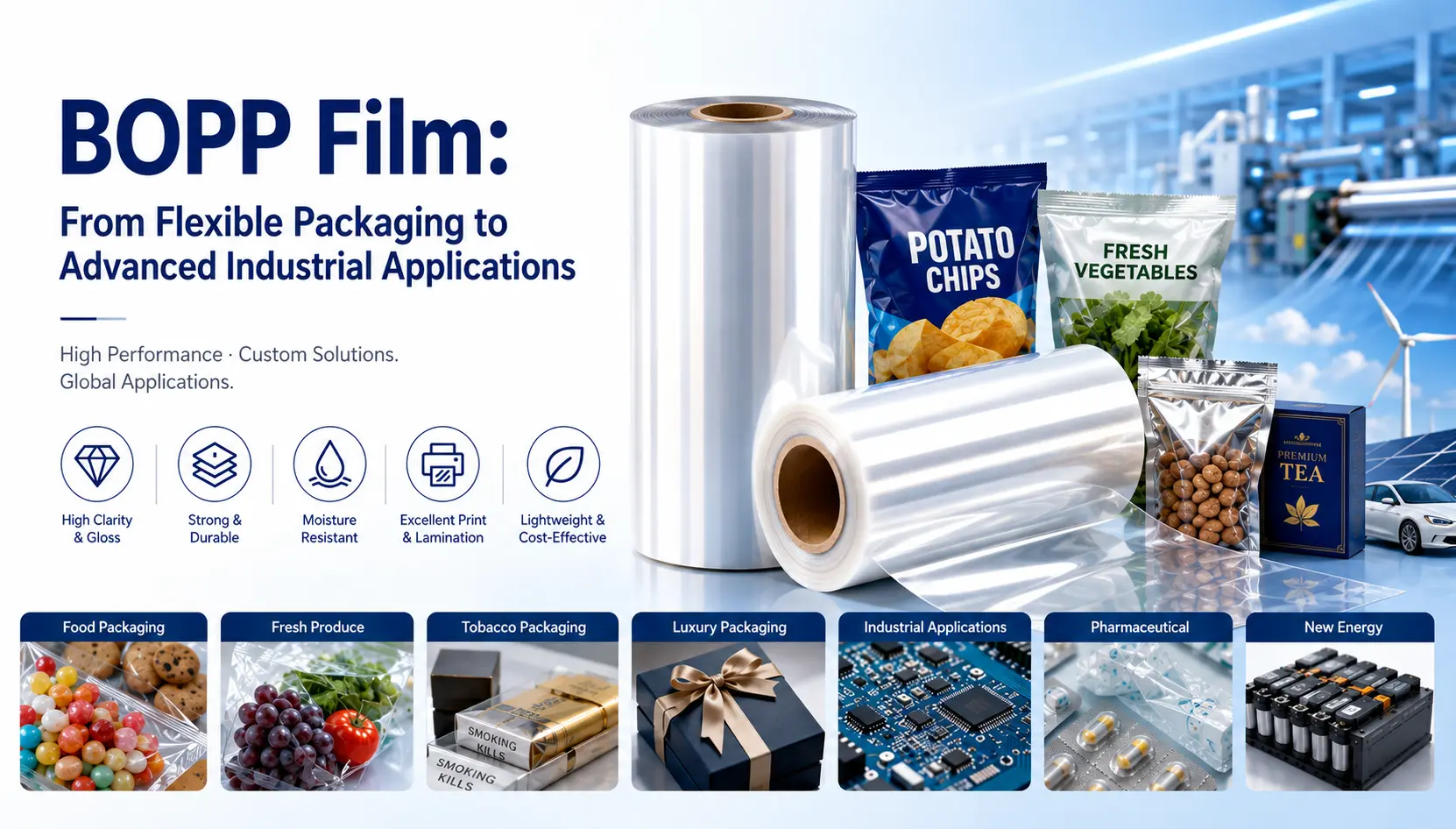
With excellent transparency, surface gloss, moisture resistance, printability, and lamination capability, this flexible substrate has long been a staple in consumer packaging. Today, customized functional film solutions are rapidly expanding into high-end sectors, including pharmaceutical packaging, precision electronics, and new energy vehicle components.
✨ 2. Core Benefits of BOPP Film
BOPP film dominates global markets thanks to its balanced performance, visual quality, processing flexibility, and cost advantages:
-
Superior clarity and gloss: Glossy grades deliver high transparency for product display, while matte finishes create a premium low-gloss texture.
-
High mechanical performance: Great tensile strength, stiffness, and tear/puncture resistance for stable printing, lamination, and high-speed packaging.
-
Strong moisture resistance: Reliable barrier against humidity to extend product shelf life.
-
Excellent printability & lamination: Corona-treated surfaces ensure firm ink adhesion and stable bonding with paper, aluminum foil, and other substrates.
-
Lightweight & economical: Optimized material structure reduces costs while maintaining packaging durability.
📈 3. Global Market Overview & Growth Trends
Driven by booming food packaging, e-commerce, pharmaceutical packaging, and advanced industrial manufacturing, global demand for functional flexible film materials maintains steady growth. In 2025, global annual demand reached nearly 11 million tons, with a 3% CAGR from 2020 to 2025. The global market size is projected to hit USD 33.19 billion by 2026, representing a 6.1% compound annual growth rate.
The Asia-Pacific region leads the industry, accounting for over 46.5% of the global market share in 2025, supported by robust packaging manufacturing and new energy industry development.Check industry professional resources for more insights on flexible packaging industry trends and material upgrades.
📦 4. 8 Common Functional Film Types & Industrial Uses
Through customized formulas, multi-layer co-extrusion, and surface treatment technologies, manufacturers can produce eight mainstream functional material grades to match diverse packaging and industrial scenarios.
▶ 4.1 High Lamination Strength Glossy Film
As the most widely used grade, this glossy material features high transparency, mirror-like gloss, and outstanding lamination stability. It enhances product visual appeal while providing reliable surface protection for daily packaging products.
Applications: Food flexible packaging, retail packaging, book covers, luxury gift boxes, printing lamination, and automatic bag making.
▶ 4.2 High Lamination Strength Matte Film
This matte material offers a soft, low-gloss diffuse surface with a premium silky texture, avoiding light glare. It retains excellent tear resistance and lamination performance for long-term high-end packaging applications.
Applications: High-end brochures, magazines, luxury gift bags, electronic product packaging, and furniture interior lamination.
▶ 4.3 Heat Sealable Film
Modified with professional heat-sealing masterbatch, this material solves the non-sealable pain point of ordinary plastic film. It supports low-temperature instant sealing and adapts to high-speed automated packaging lines, available in single-sided and double-sided sealing types.
Applications: Candy, tea, cosmetic, and daily commodity sealed packaging, as well as composite packaging mass production.
▶ 4.4 Tobacco Packaging Film
A high-precision grade produced via three-layer co-extrusion and biaxial stretching. It features stable friction coefficient, high-speed packaging compatibility (400–600 packs/min), excellent moisture/odor barrier, and precise thermal shrinkage for tight, neat packaging. The mainstream thickness for tobacco packaging is18–22μm.
▶ 4.5 Anti-Fog Film
Specially designed for fresh produce packaging, this anti-fog material prevents water vapor condensation under refrigerated and normal-temperature environments, maintaining permanent high transparency. It also delivers strong heat-sealing and puncture resistance.
Applications: Supermarket fresh fruits, vegetables, flowers, sushi, and refrigerated food display packaging.
▶ 4.6 Pearlized Film
With added pearlescent pigments and calcium carbonate, this material has an elegant satin pearl appearance and lightweight micro-void structure. Different thicknesses meet diverse cold and snack packaging needs.
Applications: 35μm grade for ice cream and chocolate packaging; 30μm grade for biscuits, puffed snacks, and daily soap packaging.
▶ 4.7 Metallized Base Film
A professional substrate for vacuum aluminum plating, featuring ultra-strong aluminum layer adhesion, excellent oxygen/moisture barrier, and UV resistance. It outperforms traditional aluminum foil and PET metallized film in recyclability and processability.
Applications: High-barrier packaging for tea, coffee, nuts, and medicines, as well as gift box decoration and holographic anti-counterfeiting materials.
▶ 4.8 Printing Film
With uniform thickness, ultra-flat surface, and stable gloss, corona-treated printing substrate provides superior ink adhesion, supporting high-precision multi-color printing. The common thickness range is 20–40μm (20μm is the most popular).
Applications: Bread, apparel, and daily goods packaging, plus book and cigarette package lamination.
✅ 5. Material Selection Guide for Packaging Projects
Choose suitable customized packaging materials based on your core project demands:
-
Application scenario: Food, fresh produce, tobacco, luxury packaging, or industrial use
-
Surface effect: Glossy for high brightness, matte for premium texture
-
Processing needs: Heat sealing, high-precision printing, or composite lamination
-
Functional requirements: Moisture/oxygen barrier, anti-fog, or lightweight performance
-
Specification matching: Reasonable film thickness and equipment compatibility
🔎 6. Conclusion
From basic printing and lamination to high-speed automated packaging, fresh food protection, aesthetic luxury packaging, and high-barrier industrial packaging, customized flexible film materials provide targeted, cost-effective solutions for global markets. Beyond traditional flexible packaging, this versatile substrate is evolving into a core high-performance material for new energy and precision electronics industries. Browse verified industrial film suppliers for your business scenarios. With continuous technological innovation, its industrial value and application boundaries will keep expanding worldwide.