
Those water droplets on your pack are quietly sending shoppers away. Anti-fog film keeps fresh produce visible — and sellable.
Stand in front of a supermarket chiller for a moment. Chances are you’ve seen this: a tray of cut fruit sealed under an anti-fog film dotted with no fog at all — or worse, a pack of fruit sealed under ordinary film covered in hundreds of tiny droplets. You can’t tell if the strawberries inside are red or brown, so you walk away. The fruit wasn’t the problem — the film was.
Anti-fog film isn’t a fancy gimmick. It’s a fairly simple fix to a very common problem. Here’s what food-grade anti-fog film is, and how to pick one for flowers, vegetables, sushi, mushrooms, or fruit. You can finish this in under five minutes — just jump to your category.
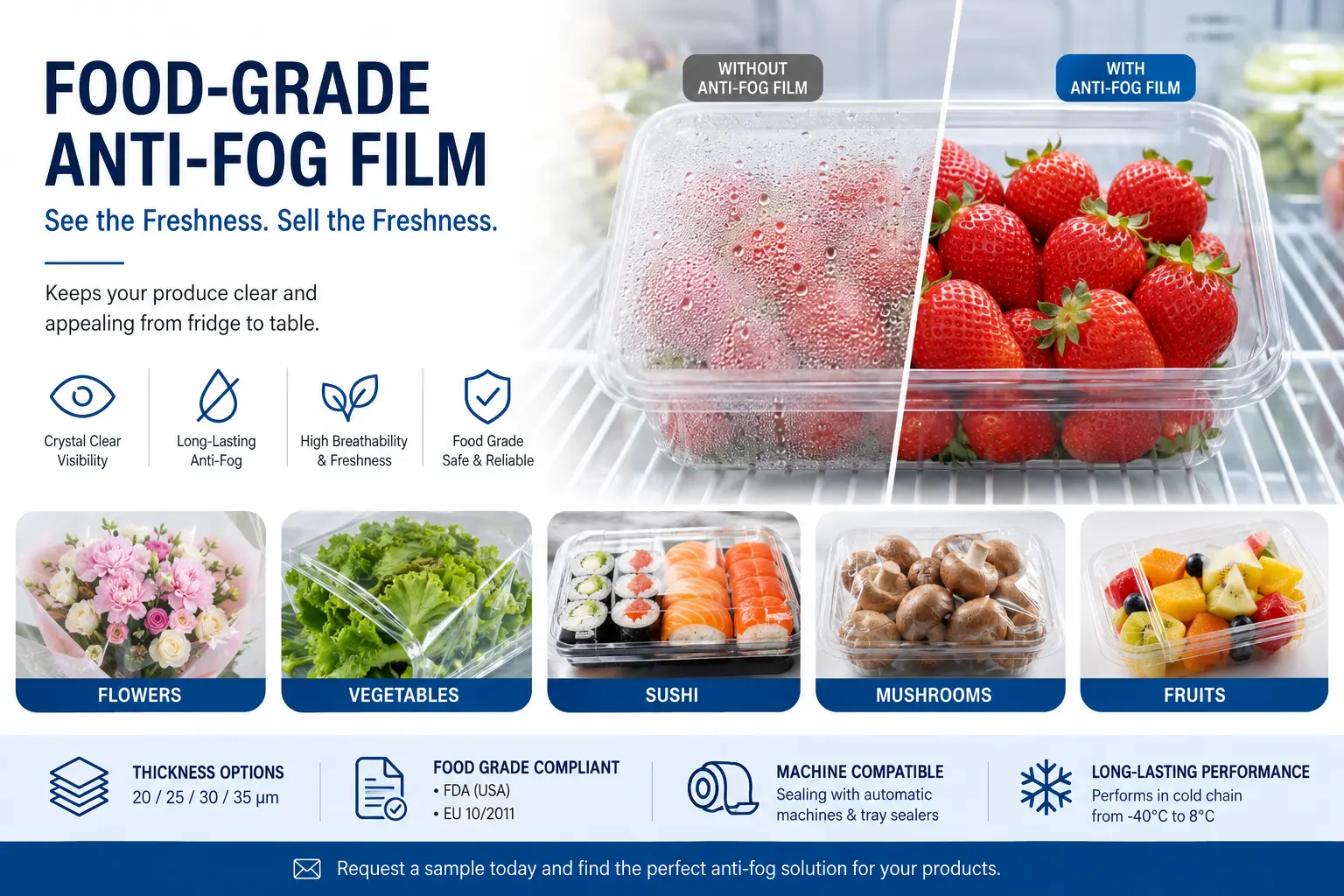
What food-grade anti-fog film solves: where the fog comes from
Fresh produce “breathes” — it keeps releasing moisture after it’s packed. Put the pack in a chiller and the temperature difference makes that moisture condense into droplets on the inside of the film. On a normal film, those droplets sit there as visible beads and block the view. The foggier the pack, the “staler” it looks to shoppers. That’s exactly the problem food-grade anti-fog film is built to fix.
How anti-fog film stays clear
The trick is in the inner surface. Anti-fog film is treated so it becomes hydrophilic — “water-loving.” Instead of forming beads, moisture spreads out into a thin, nearly invisible layer. The pack stays crystal clear, from sealing to transport to the shelf. Good food-grade anti-fog film keeps working for the whole cold-chain cycle, not just the first hour.
Five uses for food-grade anti-fog film (one film doesn’t fit all)
- Flowers: bouquets “sweat” in the cold room, and fog washes out the colors. A clear film lets customers see real freshness and cuts waste.
- Vegetables: leafy greens release a lot of moisture. You need anti-fog plus good breathability, or the pack fogs up and the leaves spoil.
- Sushi: this is the make-or-break category for grab-and-go deli counters. If customers can’t see what’s inside, they won’t buy it.
- Mushrooms: they’re moisture-heavy and delicate. Too airtight and they go bad fast — balance fog control with ventilation.
- Fruit: high-moisture fruit (strawberries, blueberries, cut-fruit trays) fogs the hardest, so this is where anti-fog film earns its keep.
If you want one film across all five, watch two things: how long the anti-fog lasts, and how well it breathes. Leafy greens and mushrooms need more airflow; flowers and sushi need maximum clarity. Tell your supplier exactly what you pack, and they can recommend the right food-grade anti-fog film for you.
What to check before you buy food-grade anti-fog film
- Thickness: common options are 20, 25, 30, and 35 microns. Thinner films conform well and cost less — good for vegetables and fruit. Thicker films hold their shape and seal cleanly — better for sushi boxes and large fruit trays.
- Food-grade compliance: if you export to the US or EU, check the paperwork first. In the US, look at the FDA’s food contact substances guidance; in the EU, it’s Regulation (EU) 10/2011 on plastic food contact materials. Most serious buyers won’t order without these.
- Machine fit: automatic packaging lines and tray sealers care about film width, sealing layer, and roll size. Confirm compatibility before ordering, and always run a sample trial first.
- Fog resistance duration: don’t just ask “does it anti-fog?” Ask how long it lasts. Several days at low temperature and high humidity is where many films fail.
The easiest way to order anti-fog film
Sample first, bulk later — that’s the safe play in this industry. Tell your supplier three things: what you’re packing (flowers, vegetables, sushi, mushrooms, or fruit), your machine model, and the thickness and size you need. The more specific you are, the fewer rounds of rework. Trial the seal, trial the chiller, trial the transport. If the sample survives all three, you’re good to scale.
In one line: food-grade anti-fog film doesn’t make food look better. It lets customers see that the food really is fresh. Pick the right thickness, get your compliance in order, and run the film through your machine — that’s the whole game.