
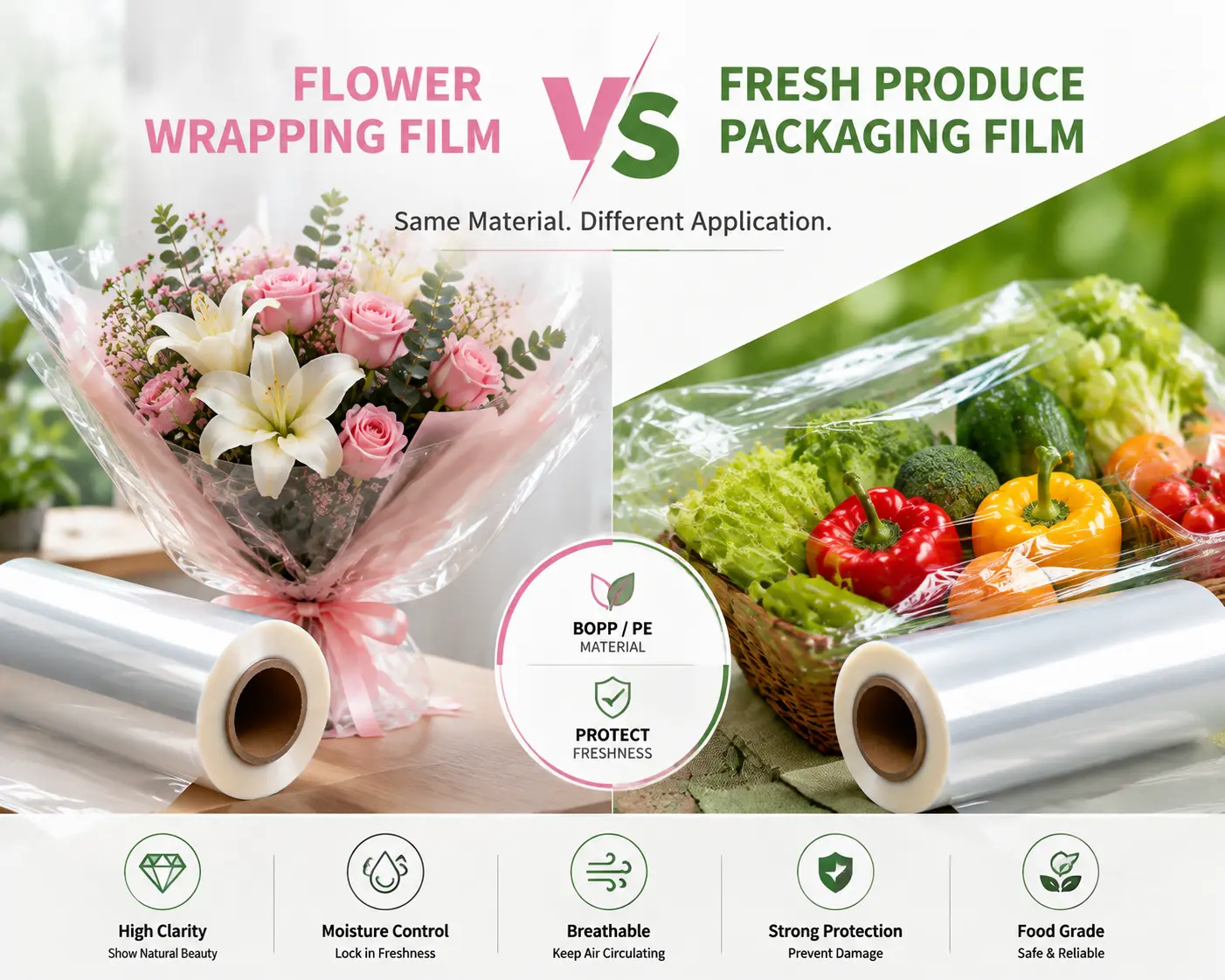
Fresh flowers, fruits, and vegetables may belong to different industries, but they share one important challenge: maintaining product quality from packaging to final sale.
At first glance, transparent flower wrapping film and fresh produce packaging film appear to serve completely different purposes. Flower film is often associated with bouquet presentation, retail display, and gift packaging. Fruit and vegetable film, on the other hand, is designed to protect fresh produce during storage, transportation, and distribution.
However, the reality is more interesting.
Many flower packaging films and fresh produce packaging solutions rely on similar polymer materials, film production technologies, and protective principles. Depending on the product, BOPP, CPP, PE, LLDPE, and other flexible packaging materials can be engineered to provide clarity, moisture resistance, mechanical protection, and packaging convenience.
The key difference is not always the base material itself.
More often, it comes down to film structure, thickness, surface treatment, permeability requirements, sealing performance, and the final packaging application.
So, is flower wrapping film really the same as fruit and vegetable fresh-keeping film?
Not exactly—but they can be much closer than most people think.
🌿 1. Different Products, Similar Packaging Challenges
Fresh-cut flowers and fresh produce are both sensitive products.
After harvesting or cutting, they can be affected by:
- 💧 Moisture loss
- 🌡️ Temperature changes
- 🌬️ Gas exchange and respiration
- 🦠 Microbial contamination
- 📦 Mechanical damage during transportation
- ☀️ Dust, light, and environmental exposure
Because of these challenges, packaging films for flowers and fresh produce often need to balance protection and product visibility.
For example, a transparent film may help protect a bouquet from dust and handling damage while allowing customers to see the color and shape of the flowers.
Similarly, transparent produce packaging allows consumers to inspect fruits and vegetables while the film provides a protective barrier during distribution and retail display.
This is why the two industries may use films with similar characteristics, including:
✨ High transparency
🛡️ Good mechanical strength
💧 Moisture resistance
📦 Lightweight protection
🔄 Flexible processing performance
The exact packaging requirements, however, can vary significantly depending on the product being packed.
🔍 2. BOPP: A Common Material for High-Clarity Packaging
BOPP, or Biaxially Oriented Polypropylene, is widely used in flexible packaging because of its excellent clarity, stiffness, gloss, and mechanical strength.
For flower packaging, BOPP film can provide:
- Excellent transparency
- Attractive glossy appearance
- Good stiffness and handling performance
- High tensile strength
- Strong resistance to tearing compared with many conventional films
- Excellent printability for branded floral packaging
These properties make BOPP suitable for applications such as:
🌹 Bouquet wrapping
💐 Flower sleeves
🎁 Gift flower packaging
🌷 Retail floral display
🛍️ Decorative transparent packaging
In the fresh produce industry, BOPP can also be used in certain packaging structures where clarity and mechanical performance are important.
However, BOPP is not automatically suitable for every fruit and vegetable packaging application.
Fresh produce packaging may require specific oxygen transmission rates, moisture vapor transmission rates, anti-fog properties, perforation designs, or heat-sealing layers depending on the product.
For this reason, film selection should always consider the specific packaging environment.
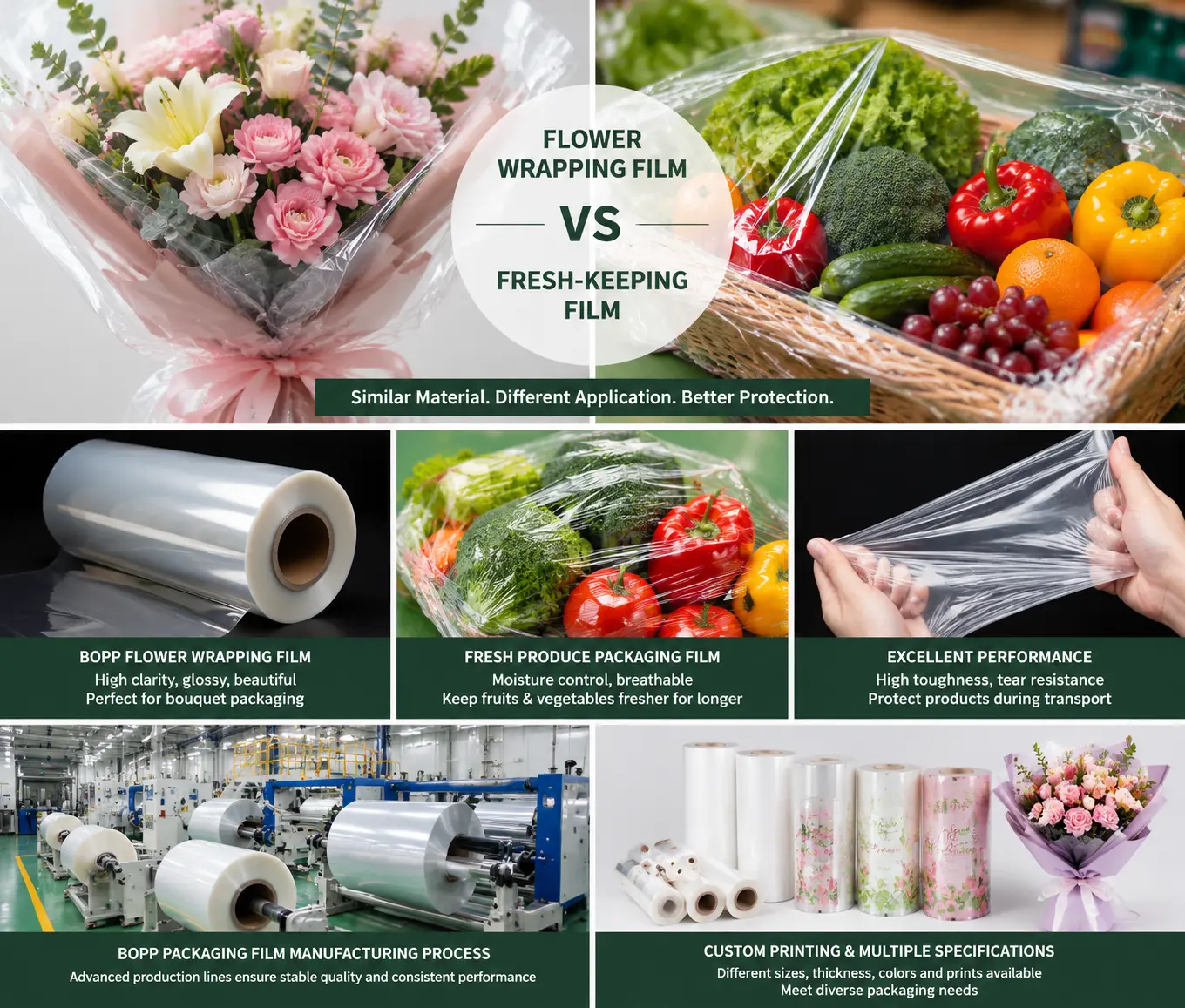
🌱 3. The Core Similarity: Both Films Are Designed to Protect Fresh Products
Although flower film and fruit and vegetable packaging film may look different, they often share several fundamental functions.
💧 Moisture Management
Fresh products naturally lose water over time.
For flowers, excessive moisture loss can lead to:
- Wilting
- Reduced petal freshness
- Loss of visual appeal
For fruits and vegetables, water loss may cause:
- Shriveling
- Weight loss
- Reduced firmness
- Shorter marketable life
Packaging films can help create a protective environment that reduces excessive exposure to external air and helps manage moisture movement.
The required level of moisture control depends on the product.
For example, leafy vegetables, berries, flowers, and root vegetables may all require different packaging designs.
🌬️ Gas Exchange and Freshness Control
This is one of the most important differences between simple protective wrapping and specialized fresh produce packaging.
Fruits and vegetables continue to respire after harvesting.
They consume oxygen and release carbon dioxide. If packaging is too restrictive, unsuitable gas conditions may develop inside the package.
Depending on the produce, packaging may therefore use:
- Controlled film permeability
- Micro-perforation
- Macro-perforation
- Anti-fog coatings
- Modified atmosphere packaging structures
Some flower packaging applications may also benefit from ventilation or perforation, particularly when flowers are transported or stored under changing environmental conditions.
However, the permeability requirements for flowers and produce are not universally identical.
The film must be selected according to the specific product, packaging format, storage temperature, and supply chain conditions.
🛡️ Physical Protection
This is an area where flower wrapping film and produce packaging film often have very similar goals.
During transportation and retail handling, fresh products can be exposed to:
- Friction
- Compression
- Dust
- Surface scratches
- Handling damage
A properly selected packaging film can provide a lightweight protective layer without significantly increasing packaging weight.
For flower packaging, film toughness helps protect delicate stems, leaves, and petals.
For fresh produce, packaging strength can help reduce surface damage during logistics and retail display.
✨ 4. Why Flower Wrapping Film Often Looks More Premium
The biggest difference between flower wrapping film and commercial fresh produce film is often visual design.
Flower packaging is part of the product presentation.
A bouquet is frequently purchased as a gift, decoration, or premium retail item. Therefore, the packaging itself plays an important role in perceived value.
Flower wrapping film may feature:
🌟 High gloss
🌫️ Frosted surfaces
🎨 Translucent colors
🖨️ Custom printing
✨ Pearl or decorative effects
🎀 Premium textures
High-clarity BOPP film is particularly suitable for packaging applications where product visibility and appearance are important.
The film can help showcase the natural colors of flowers while adding structure and visual appeal to the finished bouquet.
Fresh produce packaging, by comparison, is usually optimized more heavily around:
- Packaging efficiency
- Product respiration requirements
- Anti-fog performance
- Sealing performance
- Refrigerated storage
- Automated packaging compatibility
The focus is more functional, although appearance and product visibility remain important.
🥦 5. Fresh Produce Packaging Requires More Application-Specific Engineering
One common misconception is that any transparent film can be used as a universal fresh-keeping film.
In reality, different fruits and vegetables have different packaging requirements.
For example:
🍓 Berries may require excellent visibility and moisture management.
🥬 Leafy vegetables may require packaging with carefully controlled ventilation.
🥦 Broccoli and other high-respiration produce may need packaging structures designed to manage gas exchange.
🍎 Apples and other firm fruits may have different requirements depending on whether the packaging is designed for retail display, bulk transportation, or modified atmosphere storage.
Therefore, a BOPP film used for flower wrapping cannot automatically replace every type of fruit and vegetable packaging film.
Likewise, a highly specialized fresh produce film may not provide the stiffness, gloss, or decorative appearance desired for premium floral packaging.
The opportunity lies in selecting or engineering the right film for overlapping application requirements.
🔄 6. Where Can Flower Film and Fresh Packaging Film Overlap?
There are many situations where similar packaging materials can serve both industries.
For example, high-clarity polypropylene or polyethylene-based films may be suitable for products that require:
- Transparent product display
- Basic dust protection
- Moisture resistance
- Lightweight packaging
- Good tear resistance
- Easy manual handling
- Custom printing or branding
Potential overlapping applications include:
💐 Flower sleeves
🌹 Bouquet wrapping
🥬 Fresh vegetable overwrap
🍊 Fruit presentation packaging
🌿 Herb packaging
🛍️ Retail fresh product packaging
In these applications, the base material may be similar, while the final film specification is adjusted according to the packaging requirement.
This approach can help packaging buyers simplify sourcing when multiple applications require comparable film performance.
💰 7. Can a Multi-Purpose Packaging Film Reduce Inventory Complexity?
For packaging distributors, wholesalers, and businesses serving multiple fresh-product industries, using similar material platforms can offer practical advantages.
📦 Simplified Material Management
Instead of managing completely different raw material systems, businesses may be able to standardize around selected film families.
For example, a supplier may offer multiple BOPP or PE film grades with different:
- Thicknesses
- Widths
- Surface finishes
- Perforation patterns
- Anti-fog treatments
- Heat-sealing properties
This can simplify product selection while still allowing customization for different applications.
💰 More Efficient Purchasing
Higher purchasing volumes of similar material types may help improve supply chain efficiency.
However, cost savings should not come at the expense of product performance.
The most cost-effective film is not necessarily the lowest-priced film.
A packaging film that reduces:
- Product damage
- Packaging failure
- Excessive material consumption
- Customer complaints
may deliver better overall value than a cheaper alternative.
🏭 Easier Production Planning
For packaging film manufacturers, producing multiple application-specific products from related material platforms can improve manufacturing flexibility.
The same general production capabilities may support films designed for:
- Floral packaging
- Fresh produce packaging
- Retail overwrap
- Gift packaging
- Food packaging
- General transparent protective packaging
Of course, the final formulation and specifications must still match the intended application.
♻️ 8. Material Selection and Sustainability
Sustainability is becoming increasingly important across the global packaging industry.
Mono-material packaging structures and recyclable packaging designs are receiving growing attention because they may simplify material recovery compared with complex multi-layer structures.
Polypropylene-based and polyethylene-based films can be designed within recycling-oriented packaging systems, depending on the final structure and local recycling infrastructure.
When selecting packaging materials, businesses should consider:
♻️ Material structure
🌍 Local recycling systems
📦 Packaging weight
🏭 Manufacturing efficiency
🔄 Recyclability of the final package
It is important to avoid making blanket sustainability claims.
A film’s environmental performance depends on the complete packaging structure, collection system, recycling process, and regional infrastructure.
🧪 9. How to Choose the Right Film for Flowers or Fresh Produce
Before selecting a packaging film, buyers should evaluate the actual application rather than choosing only based on appearance.
Here are several important questions:
🌹 For Flower Packaging
Consider:
- Required transparency or haze
- Glossy or matte appearance
- Film stiffness
- Tear resistance
- Thickness
- Printability
- Manual or automated packaging
- Required ventilation or perforation
🥦 For Fruit & Vegetable Packaging
Consider:
- Type of produce
- Respiration rate
- Storage temperature
- Required oxygen and carbon dioxide transmission
- Moisture management
- Anti-fog requirements
- Heat-sealing requirements
- Packaging machine compatibility
- Shelf-life expectations
The best packaging film is always the one that matches the complete application.
🔥 10. The Real Industry Insight: Similar Materials, Different Specifications
So, what is the surprising truth?
Flower wrapping film and fruit & vegetable packaging film are not necessarily the same product.
But they are often built on similar material technologies and share several important packaging functions.
Both industries depend on flexible films that can provide:
✔️ Product visibility
✔️ Physical protection
✔️ Moisture resistance
✔️ Efficient packaging performance
✔️ Lightweight material usage
✔️ Customizable film properties
The difference usually comes from how the film is engineered for the final application.
A premium flower wrapping film may prioritize:
✨ High clarity
✨ Gloss
✨ Decorative appearance
✨ Printability
✨ Structural stiffness
A fresh produce packaging film may prioritize:
🌬️ Gas exchange
💧 Moisture control
❄️ Cold-chain performance
🌫️ Anti-fog properties
📦 Automated packaging efficiency
The underlying polymer family may be similar, but the final packaging solution should always be application-specific.
🏁 Final Thoughts: One Film Technology Platform, Multiple Fresh Packaging Applications
The packaging industry is moving toward smarter material selection rather than simply treating every application as completely independent.
For flowers, fruits, vegetables, and other fresh products, flexible packaging films can often share similar material foundations while being customized for different performance requirements.
BOPP film remains an excellent option for applications requiring high transparency, gloss, mechanical strength, and premium presentation.
PE and other flexible packaging films can provide different advantages where softness, sealing performance, moisture management, or specialized permeability is required.
The key is not to ask:
“Is flower wrapping film exactly the same as fruit and vegetable fresh-keeping film?”
A better question is:
“Can similar film technologies be engineered to meet the packaging requirements of both applications?”
In many cases, the answer is yes.
By selecting the right film material, thickness, structure, surface treatment, and functional properties, packaging businesses can create efficient solutions for a wide range of fresh-product applications—from premium flower bouquets to commercial fruit and vegetable packaging.
🌿 Looking for High-Clarity Packaging Film for Floral or Fresh Product Applications?
Whether you need BOPP flower wrapping film, transparent packaging film, custom-sized rolls, printed film, matte film, or application-specific flexible packaging materials, choosing the right specification is essential for product protection and presentation.
A professional packaging film manufacturer can help customize:
- 📏 Film thickness
- 📐 Roll width and length
- ✨ Glossy or matte surface
- 🌫️ Anti-fog performance
- 🕳️ Perforation design
- 🖨️ Custom printing
- 🔥 Heat-sealing properties
- 📦 Packaging formats for manual or automated applications
Contact a professional packaging film supplier to develop the right film solution for your flower, fresh produce, or retail packaging application.