
BOPP high-strength glossy film is becoming a key product as the packaging industry shifts from conventional films to specialty films. When many BOPP film manufacturers hear “high-strength glossy film,” their first reaction is: “We’ve been making glossy film for over a decade. What’s new to say?” However, a reality is unfolding: although they share the name “glossy film,” conventional printing-grade and tape-grade products are becoming increasingly commoditized in price wars, while BOPP high-strength glossy film, ultra-thin glossy film, and functional glossy film are opening up new price bands and application spaces.
More importantly, the real pain points of downstream bag-makers have changed. In the past, everyone cared about “Is the film transparent, bright, and printable?” Now, more and more people are asking: After printing and lamination, will the punching points and heat-sealing positions crack during high-speed bag-making? Can the bag breakage rate be reduced? Can material costs be controlled without increasing thickness or changing the structure? These questions cannot be answered by conventional glossy film. BOPP high-strength glossy film can.
1. What Is BOPP High-Strength Glossy Film and How Does It Differ from Conventional Glossy Film?
1.1 The Limitations of Conventional BOPP Glossy Film
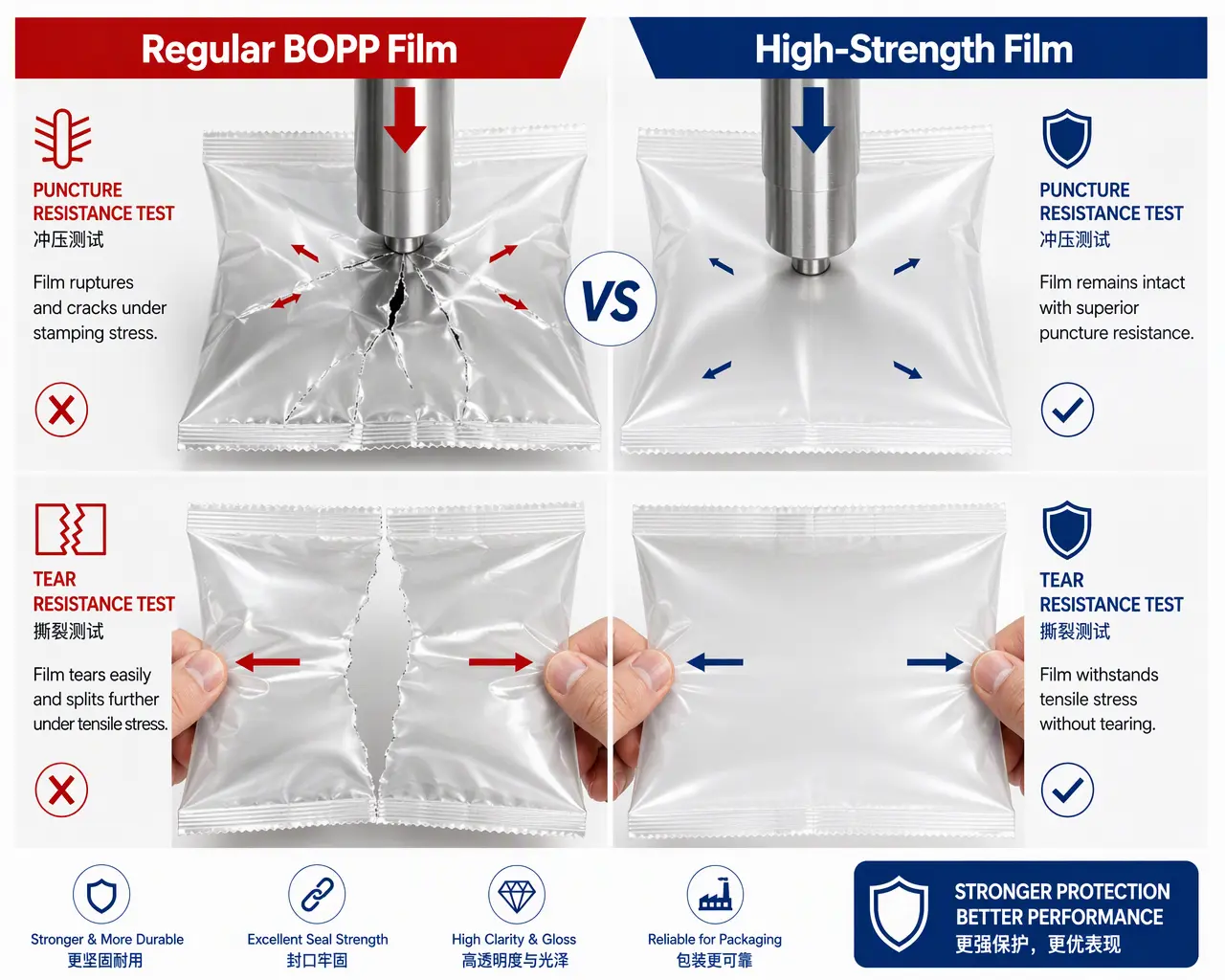
Conventional BOPP glossy film is positioned as a “transparent, bright surface.” It meets basic lamination, printing, and composite requirements. Furthermore, it offers high gloss, high transparency, and a smooth surface. However, it has a hard flaw: it cannot be directly heat-sealed into bags as a single layer; it must be laminated with CPP or PE. More troublesome is that after entering the printing—dry lamination—high-speed bag-making process, stress concentrates at punching and heat-sealing positions. Consequently, this makes the film prone to cracking at stress points, causing bag breakage, seal bursting, and high production line losses.
Traditional countermeasures each have limitations. For instance, increasing film thickness directly raises material costs. Additionally, switching to BOPA nylon or PET substrate changes the composite structure system and significantly increases raw material costs. Reducing bag-making speed sacrifices efficiency and is not a long-term solution.
1.2 How BOPP High-Strength Glossy Film Solves These Problems
BOPP high-strength glossy film works on a completely different logic. It uses PP as the substrate. Through modified formulation and biaxial stretching process optimization, it systematically improves tensile strength, elastic modulus, impact resistance, and puncture resistance without increasing film thickness. In other words, it becomes strong not by “thickening” but by “molecular orientation and formulation design.”
Take the “High-Toughness, Puncture-Resistant Series” as an example. Compare it with conventional BOPP glossy film:
| Item | High-strength BOPP glossy film | Conventional BOPP glossy film (reference) |
|---|---|---|
| Tensile strength MD | ≥140 MPa | ≥130 MPa |
| Tensile strength TD | ≥260 MPa | ≥220 MPa |
| Haze | ≤2.0% | 2.0%—2.8% |
| Gloss | ≥90% | 85%—90% |
| Surface tension (treated side) | ≥38 mN/m | ≥38 mN/m |
| Density | 0.91 g/cm³ | 0.91 g/cm³ |
Transverse tensile strength increases from a reference value of 220 MPa to over 260 MPa—an improvement of about 18%. Haze is lower and gloss is higher. Consequently, with the same glossy film, it “holds up” better on the bag-making line and “supports” fine printing orders better on the printing surface.
2. Key Properties of BOPP High-Strength Glossy Film
2.1 Mechanical Properties: Puncture Resistance, Tear Resistance, Lower Bag Breakage Rate
Key mechanical indicators include a transverse (TD) tensile strength of not less than 260 MPa and a longitudinal (MD) elastic modulus of not less than 1,700 MPa. Additionally, the nominal strain at break should be no more than 180% in MD and no more than 65% in TD.
These data mean the film is flexible and does not become brittle. In the bag-making process, cracking resistance at punching points and heat-seal positions is enhanced. As a result, the risk of seal bursting and bag breakage during load-bearing and handling is significantly reduced. For bag-makers, these are not laboratory numbers. They directly correspond to scrap rate, downtime, and delivery stability.
2.2 Optical Properties: High Transparency, High Gloss, Good Fine Printing Reproduction
Notably, high strength does not mean sacrificing appearance. The product has haze not more than 2.0%, gloss not less than 90%, and surface tension on the corona-treated side not less than 38 mN/m. This ensures firm ink adhesion. For example, for orders requiring high printing precision—such as shallow screens, fine dots, and portraits—dot reproduction is stable, with less dot loss or blurring.
Moreover, for color printing plants, this means greater confidence in taking on fine orders. For brand owners, shelf performance of packaging will not be compromised by material upgrades.
2.3 Processing Adaptability: Smooth Running, No Machine Adjustment Needed
Coefficient of friction is not more than 0.6 (according to GB/T 10006-2021). This ensures smooth running in printing, lamination, and bag-making. Thermal shrinkage at 120°C is 3.5%/2.0% MD/TD. This provides dimensional stability after lamination and reduces wrinkling. Consequently, standard specifications of 18μm and 20μm can run directly on existing machines, generally without adjusting equipment parameters.
Importantly, this point is crucial. The biggest fear for specialty films is “good performance but cannot run on machines.” If BOPP high-strength glossy film required customers to significantly modify their processes, promotion costs would be extremely high. The positioning of this product is clear: directly compatible with existing high-speed printing lines, lamination lines, and bag-making machines.
2.4 Lightweighting: Density 0.91 g/cm³, Less Material per Unit Area
BOPP itself has a density of about 0.91 g/cm³, which is lower than BOPA nylon (about 1.13—1.16 g/cm³) and PET (about 1.38—1.40 g/cm³). Consequently, for the same film area, material usage is lower. Furthermore, this also leaves room for subsequent mono-material recyclability.
3. Why BOPP High-Strength Glossy Film Is the Future: Three Driving Forces
3.1 Force 1: Lightweighting and Thickness Reduction — Thinner and Stronger Is the Real Skill
The global packaging industry’s thickness reduction trend is accelerating. In Europe, for instance, standard BOPP film thickness has migrated from 20—25 microns to 15—20 microns. Toppan Group’s new BOPP production line in Italy explicitly focuses on “thickness reduction.” By improving film mechanical strength, it reduces thickness while maintaining necessary packaging functions. As a result, this continuously reduces plastic usage.
Therefore, thickness reduction is not simply making film thinner. It means using stronger materials to make thinner film. BOPP high-strength glossy film sits right in the middle of this trend. The 18μm specification saves material and offers high cost-effectiveness. It suits conventional food bags, daily necessities packaging bags, and other light-load bag types. Similarly, the 20μm specification offers higher stiffness and firmer bag shape. It suits packaging with heavier contents and higher bag-shape setting requirements.
3.2 Force 2: Upgrading of High-End Packaging Demand — From “Adequate” to “Good”
Requirements for packaging films in consumer electronics, high-end food, daily chemicals, and other fields are rapidly upgrading. A functional BOPP film from Hainan Sainuo Industrial Co., Ltd. is one-third the thickness of a hair but strong and tear-resistant. It is capable of moisture-proofing, anti-counterfeiting, and adapting to high-end packaging. However, this is not an isolated case.
The value of BOPP high-strength glossy film lies in this: it allows downstream customers to obtain both optical quality and mechanical reliability in the same material. They do not have to choose between “good-looking” and “durable.” For example, snack bags, seasoning bags, dried food bags, daily chemical and personal care flexible packaging, and other composite bags with higher load-bearing and handling requirements are all direct application scenarios.
3.3 Force 3: Domestic Substitution — High-End Gaps Are Windows of Opportunity
China’s BOPP capacity has reached 8.4 million tons, with expectations of reaching 9.22 million tons in 2026. Despite this volume, high-end functional BOPP films still have gaps and are mainly imported. Consequently, domestic substitution of high-end products remains the future direction of the industry. At present, domestic conventional packaging-grade BOPP has achieved a high degree of self-sufficiency. Import dependence has dropped to 1.4%. This leaves only a small import demand, mainly concentrated in high-end functional film products.
Indeed, BOPP high-strength glossy film is a typical category in this gap. It does not require overcoming extreme technical thresholds like capacitor film or optical film. But in indicators such as tensile strength, thickness uniformity, and surface smoothness, it far exceeds conventional glossy film. It belongs to “reachable” high-end products. For film manufacturers with biaxial stretching process accumulation, this is one of the most realistic paths from the red ocean of conventional film to the blue ocean of specialty film.
4. Who Benefits from BOPP High-Strength Glossy Film?
4.1 Target Customer Profiles
From the technical data sheet, the target customers are very clear:
-
Bag-makers: They face high bag breakage rates and large scrap losses after lamination and punching. They want to reduce breakage rates and improve delivery stability.
-
Color printing plants: They take on shallow-screen and fine printing orders with high dot reproduction requirements. They do not want materials to hold back printing.
-
Brand owners and packaging suppliers: They want to replace part of BOPA nylon/PET composites with PP structures. They aim to optimize material costs and align with recyclability directions.
4.2 Key Application Scenarios
For example, application areas include flexible food packaging such as snack bags, seasoning bags, and dried food bags. They also include flexible packaging for daily chemicals and personal care. Other composite bags with higher load-bearing and handling requirements are also suitable.
5. Sustainability of BOPP High-Strength Glossy Film: Mono-PP Structure Is a Passport
5.1 Mono-PP Structure and Recyclability
Furthermore, this product is a mono-material polypropylene. Its density is about 0.91 g/cm³, lower than BOPA nylon and PET. This reduces carbon emissions through lightweighting. After use, it can directly enter the PP recycling stream without peeling off multiple heterogeneous material layers.
In terms of industry direction, the EU Packaging and Packaging Waste Regulation (PPWR) requires packaging to be designed for recyclability by 2030. Europe has published the CEN EN 18120 design-for-recycling standard. The PP mono-material solution uses a common criterion of PP content above 90% and compliance with CEFLEX recycling guidelines. This product’s mono-PP structure fits these directions. It can be used in flexible packaging applications such as snacks, seasonings, and daily chemicals to replace part of BOPA/PET composite structures.
5.2 Balancing Performance and Sustainability
Nevertheless, BOPA nylon and PET still have advantages in high-barrier and high-temperature retort performance. Whether to replace them must be comprehensively evaluated based on product shelf life and sterilization processes. It cannot be generalized. Thus, the value of BOPP specialty film is not “universal replacement” but “providing a better solution in suitable scenarios.”
6. Processing BOPP High-Strength Glossy Film: Tips for Best Results
Although the product can directly fit existing equipment, using BOPP high-strength glossy film well still requires attention to several aspects.
6.1 Storage and Preparation
-
Storage: Store in a dry, light-shielded environment. Recommended storage temperature is not higher than 40°C to avoid attenuation of the corona-treated layer.
-
Before machine use: Leave the entire roll to stand in the workshop environment for at least 24 hours before slitting or printing. This reduces film running and wrinkling caused by temperature and humidity differences.
6.2 Printing and Lamination
-
Printing: Surface tension on the treated side is not less than 38 mN/m. This meets conventional gravure and flexo processes. For high-precision printing orders, confirm surface tension and perform ink adhesion tests before running.
-
Lamination: Compatible with conventional dry lamination processes. Control winding tension to avoid stress concentration affecting subsequent bag-making.
6.3 Bag-Making and Quality Control
-
Bag-making: Punching and heat-sealing parameters can follow existing BOPP glossy film processes. However, if the breakage rate remains high, check adhesive curing, heat-sealing knife temperature, and bag design factors simultaneously.
Additionally, we inspect products batch by batch before they leave the factory. We can provide corresponding batch physical property test reports upon customer request. The indicators listed in Table 1 are typical production values and may fluctuate normally between batches. For food-contact packaging applications, we can provide relevant compliance documents as needed.
7. FAQ
Q1: What is the difference between BOPP high-strength glossy film and conventional BOPP glossy film?
A1: By utilizing modified formulation and biaxial stretching, BOPP high-strength glossy film improves tensile strength, elastic modulus, and puncture resistance without increasing film thickness. While conventional glossy film has a reference transverse tensile strength of about 220 MPa, the high-strength version can reach over 260 MPa. Consequently, this makes it more suitable for high-speed bag-making after printing and lamination.
Q2: Can BOPP high-strength glossy film reduce the bag breakage rate?
A2: Yes. Its cracking resistance at punching points and heat-seal positions is enhanced. Therefore, this reduces the risk of seal bursting and bag breakage during load-bearing and handling. It directly corresponds to scrap rate, downtime, and delivery stability.
Q3: How do I choose between 18μm and 20μm BOPP high-strength glossy film?
A3: 18μm saves material and offers high cost-effectiveness. It suits conventional food bags, daily necessities packaging bags, and other light-load bag types. Similarly, 20μm offers higher stiffness and firmer bag shape. It suits packaging with heavier contents and higher bag-shape setting requirements.
Q4: Does BOPP high-strength glossy film require adjusting existing bag-making machine parameters?
A4: Standard 18μm and 20μm specifications can directly fit existing high-speed printing lines, lamination lines, and bag-making machines. Furthermore, they generally do not require adjusting equipment parameters. However, if the breakage rate remains high, check adhesive curing, heat-sealing knife temperature, and bag design simultaneously.
Q5: Is BOPP high-strength glossy film recyclable?
A5: The product is a mono-material polypropylene with a density of about 0.91 g/cm³. After use, it can directly enter the PP recycling stream. This aligns with the direction of PPWR and CEN EN 18120 for PP mono-material recyclable packaging.
Conclusion: The Future of BOPP Is Not Larger Capacity, but Stronger Performance
Ultimately, the story of BOPP high-strength glossy film is essentially a transformation of the industry from “making film” to “making materials.” The era of conventional glossy film is not over. However, it no longer rewards new entrants. Therefore, what truly creates incremental value are products that make glossy film stronger, make strength thinner, and make thinness performant. High-strength glossy film, ultra-thin glossy film, and functional glossy film together form the landscape of BOPP specialty film.
BOPP high-strength glossy film is not just a concept. It corresponds to fewer broken bags on the bag-making line, stable delivery of fine orders in color printing plants, and a balance between cost and recyclability for brand owners. By turning a “transparent film” into a “structural material,” it delivers real value. The future of BOPP is not in larger capacity, but in stronger performance. Whoever can make a transparent film with performance that others cannot achieve will secure a real ticket in the competition of the next decade.