
Extreme Temperature Sealing of High-Speed Heat-Seal Film | Reduce Production Waste
Modern automated packaging lines pursue faster speeds and steadier continuous operation. Traditional sealing films can no longer match upgraded production standards. In fact, ordinary packaging films suffer from unstable sealing performance under extreme and fluctuating temperatures. They crack easily and produce large numbers of defective products. These flaws seriously restrict production efficiency and raise manufacturing costs. For this reason,high-speed heat-seal film has become an essential upgraded material for modern packaging factories. This professional packaging material features ultra-stable thermal sealing performance. It adapts to high-speed continuous operation and complex temperature environments. Meanwhile, it effectively reduces material waste and lowers overall production costs. According to authoritative industry market research, high-performance thermal sealing materials have become the core upgrade direction for modern automated packaging production lines global heat seal film industry development trends.
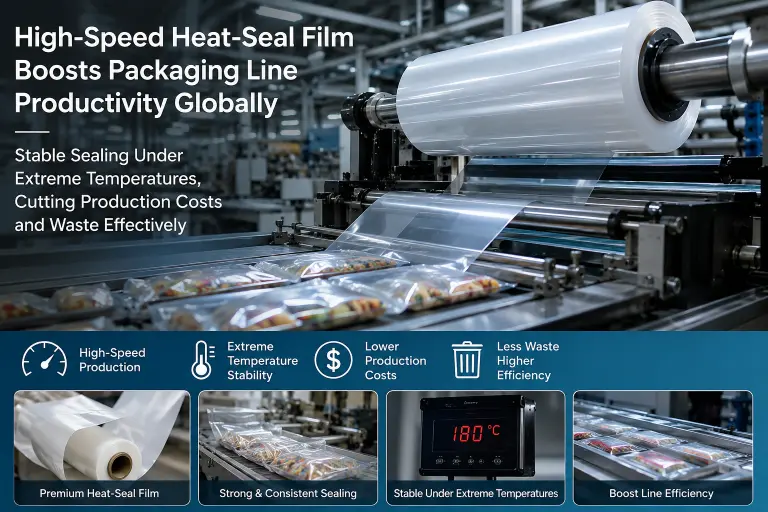
Solve Automated Packaging Bottlenecks With Reliable High-Speed Heat-Seal Film
Automated intelligent packaging equipment puts forward stricter requirements for film sealing stability. However, conventional packaging materials have obvious performance defects. They are prone to weak sealing, seal rupture and edge curling during long-term high-speed operation. These continuous defects lead to frequent production shutdowns and increased rework costs. As a result, many packaging enterprises face low yield rates and poor profit margins. On the contrary, upgraded high-speed heat-seal film perfectly solves these industry bottlenecks. It delivers consistent sealing quality without temperature sensitivity. Furthermore, it supports long-term, stable and uninterrupted automated production, which greatly improves operational fluency.
Stable Sealing Performance of High-Speed Heat-Seal Film in Extreme Temperatures
Customized for high-volume and high-precision automated packaging scenarios, high-speed heat-seal film adopts upgraded thermal sealing formulas. Different from ordinary films, it maintains airtight and firm sealing performance in both high-temperature workshop environments and low-temperature cold chain scenarios. It completely avoids common production defects such as loose seals, film cracking and edge warping. In addition, its stable physical properties fully adapt to the high-frequency working rhythm of intelligent packaging lines. Therefore, manufacturers can obtain uniform and high-standard packaging results in every batch of products.
Cost Reduction & Higher Throughput Brought by High-Speed Heat-Seal Film
The biggest competitive advantage of high-speed heat-seal film lies in its outstanding cost-saving and efficiency-improving capabilities. In actual production, unstable sealing is the main cause of material waste and defective products. This optimized film greatly reduces defective rates and effectively cuts raw material consumption. It also lowers manual rework and post-processing costs for enterprises. At the same time, its excellent high-speed compatibility maximizes the operating efficiency of automated equipment. It shortens single packaging cycle time and significantly improves overall production throughput. In short, it brings stable and tangible economic benefits for packaging factories, food processing enterprises and cold chain logistics industries.
Multi-Scenario Application & Versatility of High-Speed Heat-Seal Film
In addition to extreme temperature resistance and high-speed operational adaptability, high-speed heat-seal film also has excellent physical toughness and sealing uniformity. It boasts strong scenario adaptability and can serve multiple packaging fields. It is suitable for flexible food packaging, composite film product packaging and daily industrial product sealing. Thus, it can meet the diversified production needs of global manufacturing enterprises. Whether in high-temperature processing environments or low-temperature cold storage and transportation links, the film can maintain durable and tight sealing quality. It effectively protects product packaging integrity throughout storage, transportation and sales.