
Wondering how to choose the right stretch film gauge? Learn why thicker stretch film gauge is not always better, explore standard thickness specifications, and get expert pallet wrapping selection tips to cut costs and boost cargo safety.
Many warehouse managers, logistics operators, and procurement buyers hold a long-standing misconception: the thicker the stretch film gauge, the safer the pallet load. This traditional mindset leads most enterprises to over-specify packaging materials, resulting in unnecessary packaging costs, extra waste, and even unstable wrapping effects. In modern flexible packaging manufacturing, stretch film performance depends on material formula, stretching rate, and tensile strength — not simply thickness. This guide explains how to select the optimal stretch film gauge for different shipping scenarios, balance load safety and cost control, and avoid common purchasing mistakes.
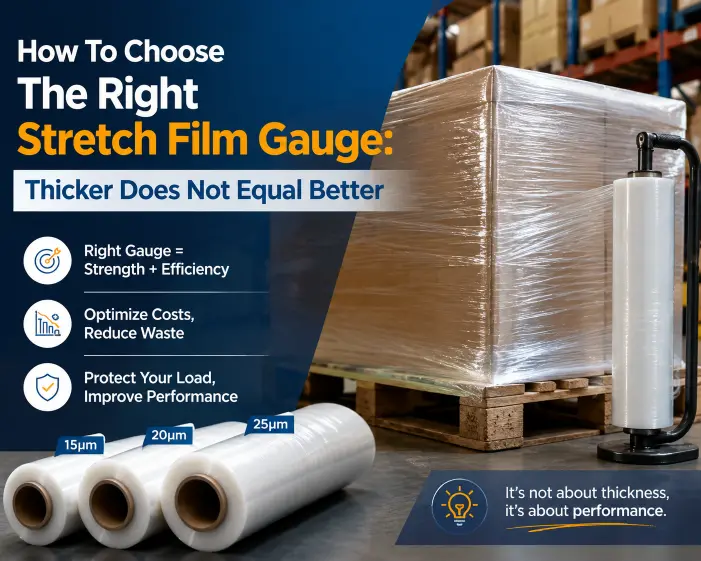
What Is Stretch Film Gauge? Core Stretch Film Thickness Standard For Buyers
In the global packaging industry, “gauge” is the mainstream unit for measuring stretch film thickness, with a clear conversion standard: 1 gauge = 0.254 microns. The higher the gauge number, the thicker the raw film. Common commercial specifications include 60ga, 70ga, 80ga, 90ga and 100ga, among which 80-gauge film is the universal industry standard, suitable for most conventional pallet loads within 2200–2400 lbs.
However, gauge only represents the original thickness before stretching. Many buyers ignore core factors like pre-stretch technology and raw material formulation. High-performance nano-modified thin-gauge films can deliver stronger tensile force and puncture resistance than ordinary thick-gauge films, which is why thicker film never equals better packaging performance.
Why Thick Stretch Film Gauge Is Not Better? 3 Key Disadvantages
1. Higher Comprehensive Packaging Costs
Excessively thick stretch film increases single-pallet material consumption directly. For enterprises with large-scale daily packaging, the cost gap accumulates rapidly. Meanwhile, thick films have lower stretch yield, cannot be stretched fully during machine wrapping, and produce more residual materials, further raising long-term logistics packaging costs.
2. Poor Load Adaptability & Hidden Safety Risks
Thick-gauge films feature high stiffness and poor flexibility. When wrapping light, fragile or irregular goods, excessive tension cannot be buffered effectively, easily causing product extrusion, deformation or surface damage. In addition, thick films fit poorly with pallet surfaces, leaving gaps that fail to fix goods stably, leading to cargo shaking or slipping during long-distance transportation and ocean shipment.
3. Incompatible With Automated Wrapping Equipment
Most modern automatic wrapping machines are calibrated for standard and thin-gauge high-tensile films. Overly thick films require higher machine tension to stretch normally. For low-power equipment, thick films cannot be stretched evenly, resulting in loose wrapping, wrinkled film surface and unqualified packaging effect, seriously reducing packaging efficiency.
How To Select Perfect Stretch Film Gauge: Practical Pallet Wrapping Guide
Professional stretch film gauge selection should be based onload weight, cargo characteristics, transportation mode and wrapping equipment. Below is a industry-verified matching standard for global procurement reference:
1. Light Loads (≤800 lbs): 60–70 Gauge Thin Film
Suitable for light carton goods, daily necessities and small batch cross-border e-commerce parcels. High-quality thin-gauge stretch film adopts imported LLDPE raw materials with modified formula, featuring high elasticity and high stretch ratio. It can fit tightly with light loads without crushing goods, achieving 15–20% cost savings compared with conventional thick films.
2. Medium Standard Loads (800–2400 lbs): 80 Gauge Universal Film
As the most cost-effective universal specification, 80ga stretch film balances tensile strength, puncture resistance and flexibility perfectly. It adapts to manual and machine wrapping, suitable for most industrial product pallets, daily logistics turnover and container transportation, and is the preferred specification for most medium-sized enterprises.
3. Heavy & Sharp Loads (≥2400 lbs): 90–100 Gauge High-Strength Film
For heavy machinery parts, building materials, hardware products and goods with sharp edges, thick-gauge films are required to enhance puncture resistance and load stability. It is worth noting that high-load packaging does not blindly pursue maximum gauge. Optimized formula 90ga high-tensile film can completely replace ordinary 100ga film, ensuring safety while reducing material consumption.
Top Stretch Film Gauge Buying Mistakes Every Procurement Should Avoid
After serving global packaging buyers for years, we summarize three typical misjudgments that cause waste or packaging failure:
Mistake 1: Judging quality only by gauge number Many suppliers falsely increase gauge data with inferior raw materials. True high-performance films rely on molecular tensile technology. A standard 80ga premium film outperforms unqualified 90ga thick film in tension and toughness.
Mistake 2: Uniform thick film for all loads Using thick film for light loads causes serious cost waste; using thin film for heavy loads leads to cargo collapse. Classified matching is the core of efficient packaging.
Mistake 3: Ignoring pre-stretch rate matching Thin-gauge high-pre-stretch films require professional machine equipment to support performance. Matching film specification with wrapping equipment is the key to stable packaging effect.
Expert Stretch Film Gauge Tips: Balance Safety & Cost-Effectiveness
The core principle of stretch film gauge selection is matching performance with demand, rather than blind thickness superposition. With the upgrading of LLDPE modification and nano-stretch technology, modern thin-gauge stretch films have broken the traditional thickness-performance limit, helping global buyers reduce packaging costs, cut plastic waste and meet sustainable environmental protection requirements.
As a professional stretch film manufacturer, we provide custom gauge customization, formula optimization and free packaging solution testing for global wholesale buyers. Whether you need standard universal films or high-strength customized stretch films for special scenarios, we can provide cost-effective one-stop packaging solutions.
Contact us today to get a tailored stretch film gauge selection guide and reduce your pallet packaging cost efficiently.